the Fulcrum to Success
“Work is a tonic which exuberates mentally, morally, and physically the man who wisely adjusts himself to it.” = success.
- A Fleece of Gold by Charles Stewart Given.
Newly hired, I moved into the TBA office on a Monday morning. Workwise, the next two weeks were among the most intense weeks of my life. The real turning point in the physical evolution taking place in the Barrio. The fulcrum to change. This chapter is where Washington crossed the Delaware River.
There was no time to waste. Before looking at the rehab, the first things I did was to fire the construction manager for the Self Help Housing Project. I asked him what he had done since he was hired. He spoke for an hour, but how far had the project advanced? He gave me a tedious explanation as to why things were pretty much as they were when I left. I listened. The families had been interviewed by Terry Johnson, a banker from Pima Savings and Loans, and all seven families were pre-approved for a home loan. Once pre-approved by the Savings and Loans, a regular commercial bank had agreed to provide the construction financing. All this was started before I had left for Texas and latter completed by Ellen.
“So, have we started construction?” I inquired.
“Oh, no! There is much to do before we get to that point. Soil compacting, water and sewer lines, electric, street, curbs, and the sidewalks need to be done first…”
“You have been getting a salary for how long?”
“Well, it is not like that. You must understand that this is the first time anyone has done something like this around here. This kind of thing takes time.”
“I want to thank you for your work, but we are no longer in need of your expertise. I will be handling it from now on.” I didn’t really know what I was getting into, nor did I have the expertise that I was expecting from him, but I would not take twelve months to fire myself.
Next step. That same day I spoke with Jimmy, the Rehab Specialist.
“Jimmy, why don’t we hire some of the kids from the Barrio to do some of the rehab work.”
“We can’t.” He responded much too quickly. “The City has given us the rules of the unions. The rules say that if you don’t have a contractor’s license, you can’t do more than $2,000 worth of work on any residential building, unless it is your own. Also, that no worker can get more than $200 in pay for work done on any one house.”
“I see. Have you asked any of the contractors you have used to hire anyone from the Barrio?”
“I have mentioned it to them, but so far no one has done it. They say they can’t find quality workers.”
“Is that true?”
“Well,” Jimmy said, “I have looked around and I am not impressed by the young people I see around here.”
“I see.” I told Jimmy to keep an eye on the two houses under Rehab at the time, but not to start any new ones. Apparently ignoring me he said, “The Rehab Advisory Council is meeting tomorrow to review the next batch of houses. Maybe you want to come and meet with them?”
“Cancel the meeting!” I responded. “Tell them I’ll meet with them in two weeks.”
Then I took pen and paper and in the next few days of uninterrupted work I did a complete and comprehensive visit and surveyed, house by house, every single home in the Barrio that showed disrepair. I developed a rating order and began to look at the condition of the roofs, at the plaster and paint, and the doors and windows. I looked at the landscaping and then the interior. I inspected the conditions of the structural walls, the ceilings, the plumbing, and the electrical, and I wrote it all down, including a list of materials, cost, and schedule of work per house. I spent hours and hours knocking on doors, getting the information, analyzing it, and organizing it. Then I organized it in different file folders and placed all the roofing needs in one folder, organized their needs from the urgent, but easiest, to the very difficult. I did the same with all the plaster and painting, from needing only a good coat of paint, to wall repair, total re-plaster and paint, to critical reconstruction to prevent collapses. I lined them up from easiest to most difficult and did the same for doors, windows, and interior work. Plumbing and electrical had to be set apart.
Then I called on four kids and one roofer who lived in the Barrio. The four of them were excellent workers who had worked with me and the YWCA in Creative Teen Power four or five years before. They were now more mature and experienced after having been in the labor force for a while. The fifth and oldest person, also from the Barrio, was a man who had great roofing experience and knowledge. I hired them.
After they had filled out the paperwork with the secretary and accountant, we went to the Tool Library and distributed all the tools needed for the work ahead. They would buy their own tools along the way. We climbed on the first roof where I set them to work once again for the first time in the Barrio in five years. The day before, I had talked to one of the owners on my list, a black single mother who had an old asphalt tile pitch roof that was showing wear and tear and had a large leak over the kitchen area, not easy, but an emergency. I had a contract for her to sign for a cost of $1,600 material and labor, the amount to be paid by a grant from the TBA. We would replace all the old shingles and plywood as needed. I had also ordered some materials from the lumber company who knew me from when I bought materials while working with the status offenders and the YWCA. I told them of my plans with the CDBG grant. Then I told the kids to start cleaning up and do preparation work by stripping off the old roof and covering it with plastic until the materials arrived the next day. The delivery came early next morning.
In two or three days they were done. I told them to clean up the site very well.
“There better not be a single loose nail on the ground anywhere. Then go and check the next house.” I gave them the list of materials I had prepared and told them to verify the need and then go to the lumber company and order the material. I would sign for it. They divided the work amongst them and got started.
That afternoon Jimmy came over very worried and said, “You can’t do that!”
“Can’t do what?”
“You can’t just hire anyone, and you can’t just go and buy material like that.”
“Why not. I just did.”
“For one, you don’t have a license. And two, we must tell the City what we are going to buy. They have set a limit. Then they give us the money to buy it. Then we show them the receipts after we buy it, so that we can give them the next list of what we need to buy next, so they can give us the money for that.”
“Says who?”
“They do.”
“And you listen to them?”
“Of course, I do.”
“Do the contractors they hire do it that way?”
“No, of course not.”
“Jimmy, I have been thinking that we have a large warehouse at our disposal, and I see you guys have put the entire Tool Library inside it. Excellent, well done! It only takes one fourth of the warehouse space. Here is the list of all the materials we are going to need to start in the next three months to do work on twenty houses, and it all will fit in that warehouse. Call the lumber company and ask them to give us a good discount and to deliver the materials to the warehouse.”
“We can’t do that!”
“Why not?”
“You are crazy. The City will not let you. That is not how it is done. You do not understand.”
I am a patient guy.
“The telephone is over there, Jimmy. Pick it up and call the lumber company.”
“They won’t send you the materials.”
“Oh, yes, they will. Go ahead and give it a try. Listen, we have the money earmarked. We are going to do all this work. The money is to get things done. We are going to document where every dollar goes, and account for every nail. Now go and place the order.”
“I won’t do it! The City will not approve.”
Maybe I am not that patient. I went to the phone, called the lumber company, and read them the long list of materials I had in front of me. Told them where to deliver them and gave them my name and the TBA name and account. Then I gave the list of materials to Jimmy and told him, “They will deliver tomorrow early, please be there and check to make sure it is all there and that it is proper material in good condition. Make sure the 2x4s and the 2x6s are straight. But don’t worry too much, this company is good at what they do. Bring me the invoice.”
“I don’t know that I want to be part of this,” he said.
“Jimmy, you are a nice man, a good person, but you are not the kind of Rehab Specialist that we need here. You have one more week of work, two weeks of pay, finish with the house that you have a contractor working on, then you can go home. And by the way, give me the list of contractors from the pool that the City uses. I want to blacklist all of them and never let them work on any house in the Barrio as of today. If the City uses them, they cannot be any good.”
“Am I fired?”
“Yes.”
I didn’t always make friends. Before the week was over and Jimmy had left, I had hired five more kids from the Barrio. My policy was that to work in the Rehab Crew, you had to live in the Barrio. As the word got out! Many kids who were born here but had moved away, began to come back and move in with a cousin or uncle or grandparents, so that they could be hired. Correcting the weakest link in the Barrio recovery chain was now in place!
Two weeks later, I hired five additional kids and placed them under the first workers, who were now crew leaders, splitting the group into three crews, while slightly increasing the salaries of the original five. Two weeks later I hired five more, continuing to use the original five as crew leaders, with corresponding pay. We now formed into five crews, three in roofing and two plastering, repairs, and painting under new contracts. To abide by the rules, each new roofing contract was completed for less than $2,000. After one roofing contract was signed off, next day a separate different contract would be started for plastering and painting. Every few weeks, we hired a few more, some of them experienced young-adults coming back to the Barrio, until we had thirty-two kids working on ten houses at the same time with salaries incrementally going up as responsibilities increased on each crew leader. Now we also had a supervisor, since they had to train the new recruits as well. At first, I kept track of their hours and paychecks, and at the proper time I would get up on a roof and ask one or two workers to trade roofs or walls with the ones across the street to keep their wages under $200 per contract. I saw how now and then they would bring a father or an uncle to show them more advanced skills as the job demanded of them but said nothing of it. It was interesting to notice that the first job chosen through this process for the first crew of these mostly Hispanic roofers and plasterers fell on the home of a black family. I didn’t know then or now if this was to be significant.
The first few jobs of each trade were simple enough to see who needed to gain more experience. After the more complex jobs, I split them into more crews, a balancing act, increasing their salary as they learned and earned it. It had to be tailored based on performance, all within the market rate. Since adding to each crew, each worker may have a different salary, I had to shift schedules and jobs around like musical chairs to keep every worker’s number of hours from reaching $200 in pay, while keeping continuity and yet diversify their experiences. Understanding my thinking, soon they were keeping tab on their own hours and rearranging places among themselves. These kids were sharp! Their sense of responsibility was astounding. They were thirsty for learning, and they did not abuse their freedom to use their initiative.
Toward the end we were moving inside the houses and repairing or rebuilding partitions and cabinets, doors, and window. For plumbing, electrical, and finish-carpentry, we hired licensed individuals and gave each a helper to learn.
I still had final responsibility and had to verify how many hours, and at what pay scale for each kid, while keeping an eye on the supplies, preparing the next batch of materials, and signing up more kids. Verifying is easier than calculating from scratch, we were only four; Irene, very busy, and the accountant did some of that, while I wrote new contracts, closed finished work, did the payroll, helped move tools and materials around to keep the crews well supplied and ordered new tools. José was busy fixing broken tools and keeping them all sharp. As you share responsibly, you share power. A specified amount for tools was an acceptable expense with CDBG funds, so we got two cement mixers and a few more power tools. I convinced a friend, Dr. Kutcher, to give us a “loan” to buy a tractor with a frontend loader, because we could not buy expensive new equipment, over a certain amount, but we could rent it, so we worked out with the doctor where he bought the tractor and we rented from him in a rental agreement with the option to buy at the end. That was allowed. This was the arrangement Williams tried to sabotage. It is interesting that often when someone begins to get things done, there are those who try to harm it.
Here I call them kids, although they were no longer kids, because they were mostly from 18 to 22 years of age, and I had known many of them since they were 13 and 15 years old. At our best point, we had thirty-two kids working on over ten houses simultaneously. They worked on a total of 120 houses. I loved seeing those young characters, full of life and energy, eager to work, with pride in what they did, fixing their neighborhood’s houses, even their 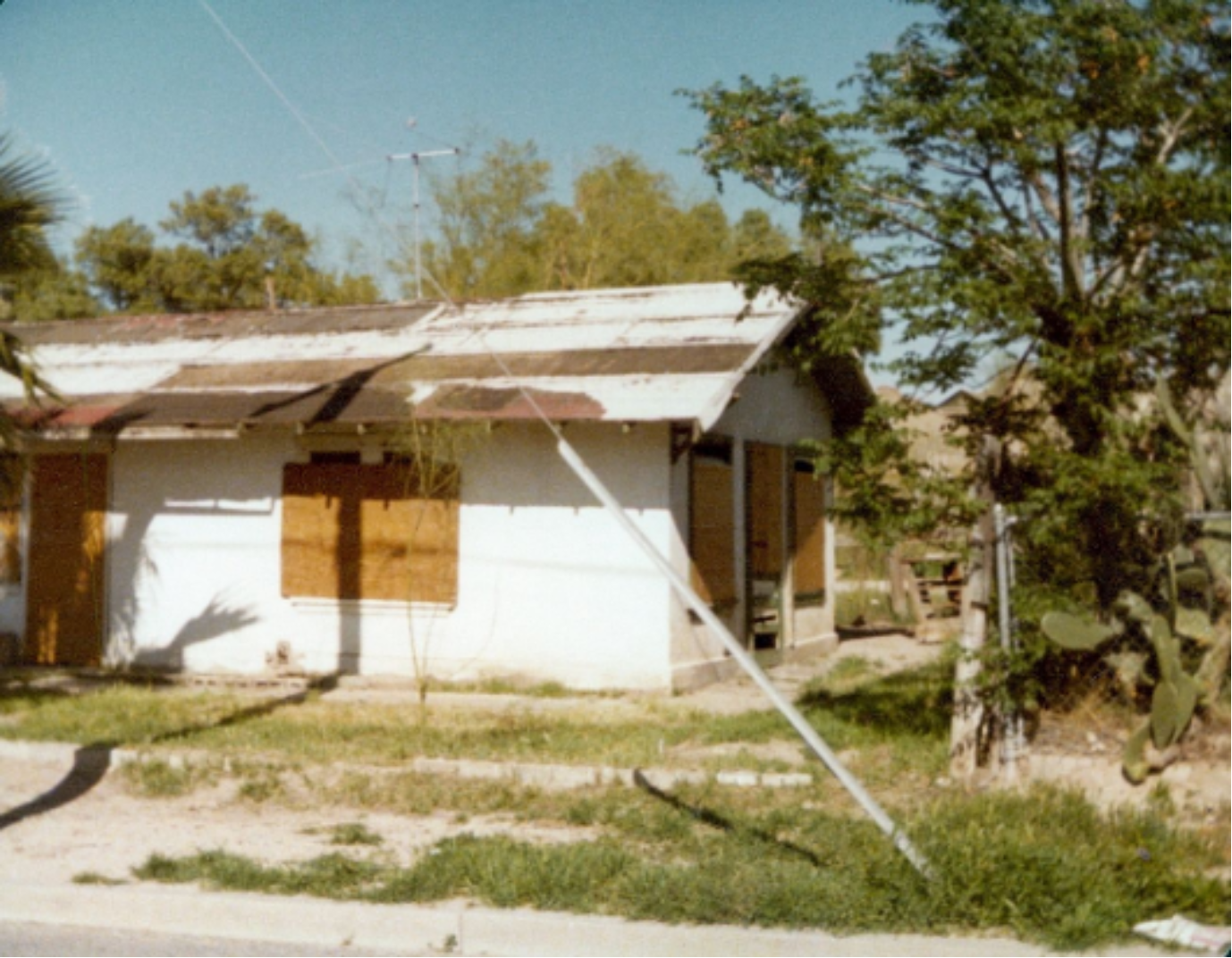 own. This is not a small accomplishment.
One hot afternoon, wiping the sweat from my brow, I sat on a log in the shade and looked at them hard at work. Memory took me back with some of them who were the same kids we had in that first YWCA group of Creative Teen Power, when I had almost given up on them as hopeless. They were the very first ones who had been initially unresponsive to me, and we had never known then that we would later come so far together, but ever since I saw little Charlene winding the film that Jose had produced through that projector, I knew they all had it in them. I knew, and maybe they knew it too. It only takes taping into the right chemistry. Things are seldom what they appear to be. They were all true Americans. However, I began to notice that they were not working for me but for their Barrio. I was just an outsider.
I don’t mention names because I would have to mention all of them, but years ago I got to know many of them well. Now the same kids were in leadership positions. Peer pressure was now operating in the positive direction. We, or rather they, rehabbed a hundred and twenty houses with 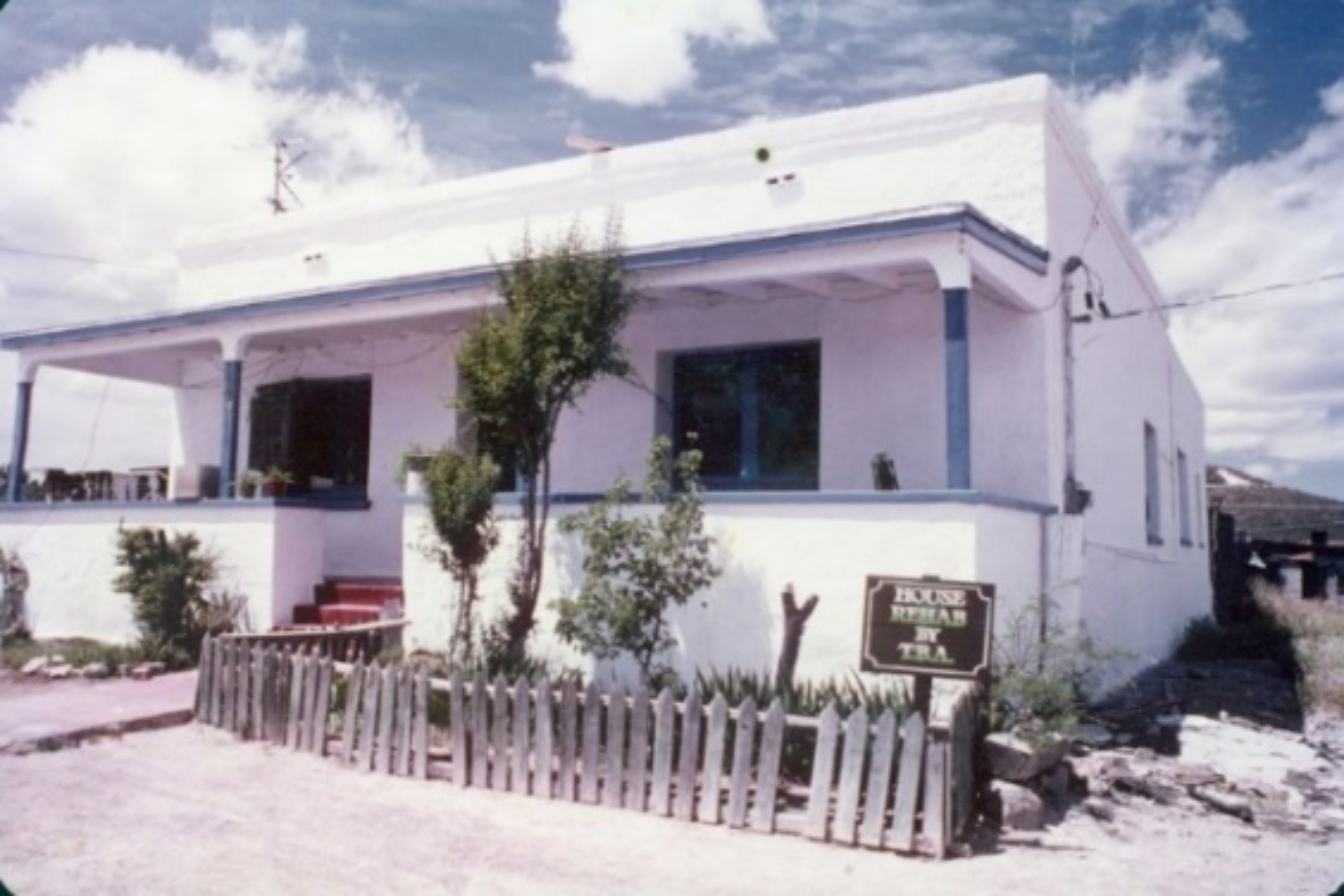 different levels of complexity, always ending with a fresh coat of paint.
The first picture shows a house where the family had gone past ‘the edge of homelessness.’ We tried to catch them before they got there, and a few others after.
The next picture on another house was taken as the house was finished but before the crew installed a new fence. The signs you see here, saying “HOUSE REHAB BY TBA” were done by a local artist and were so good they were all stolen as souvenirs as fast as we could put them up.
Dan Benitez the Director of the City’s Department of Human and Community Development and some of his staff did everything in their power to stop us, to defund us, and finally after a year of trying, they succeeded. However, by then we had done all the emergency rehab that needed to be done. The Self-Help Housing group by then started, was well on its way, and as it had its own private financing funding, the City could not touch it.
When the City discontinued funding administrative and rehab funds, Irene and I stayed as volunteers until the Rehab was completed, and I stayed with the Self Help Housing for close to another year without pay. The Department thought that with no administrative funds, the TBA would collapse, but it did not.
After a few more incidents, I’ll go into how the Self-Help Housing Program came to be, and how it was completed. It was not only the one year of job creation with the Rehab crew, but it was also the combination of factors, including the Creative Teen Power, the Carrillo Pool, the Mini Park, The Centro Historico, the series of Sunday breakfasts and celebratory events with music and socializing, the Tool Library, and the Board’s decisions, all individually self-motivated that affected and improved the neighborhood environment. Increasingly, we began to share power.
The Self Help Housing program worked because the residents took control of their habitat and their homes, and most of all, because we had brought the youth back into the Barrio. Pride, Family, and Hands was the bond, and the Self Help Housing project cemented it by building the first new homes in the Barrio in years. It reversed the direction for good, turning the downhill spiral into a well-rounded trickle-up outcome[xxxiv].
Self Help Housing is building and owning your own home with others like you, it is sharing the power. A few said it took too long, but the wholesome impact in the Barrio justified it. We soon had a group of twelve families waiting next in line to do the same. The twenty percent sweat equity in two years was equal to a very good full-time salary.