Barrio Historico and Ideological Clash
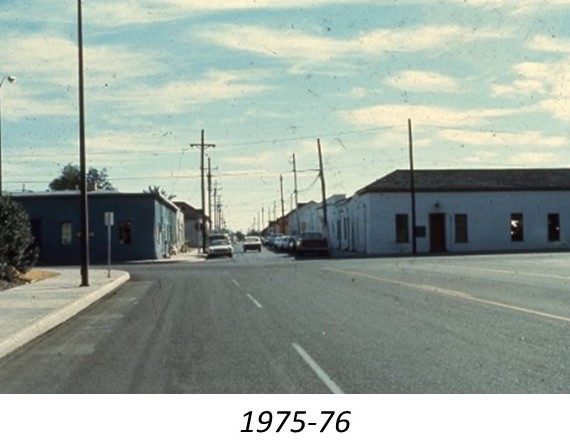 With two other new VISTA volunteers, both from California, I started working at Tucson Design Center, an architectural office with a staff of seven, owned and run by Jodi Gibbs. Jodi was a tall slim, very intelligent man who ran a very well organized and efficient small operation doing lots of community work. His firm was located in a restored adobe building inside the periphery of El Barrio, or Barrio Libre, Barrio Viejo, or Barrio Histórico, names by which it was locally known translated as: Free Neighborhood, Old Neighborhood, Historic Neighborhood, the name used at that time depending on the age and origin of the person you were talking to. Jody had finished a job commissioned by the City of Tucson to design and have built new cement block bathrooms with full plumbing for a high percentage of the older homes in this Barrio, until then lacking inside plumbing or bathrooms. Conditions ranged widely in this two hundred-and-eighty-house traditional family neighborhood.
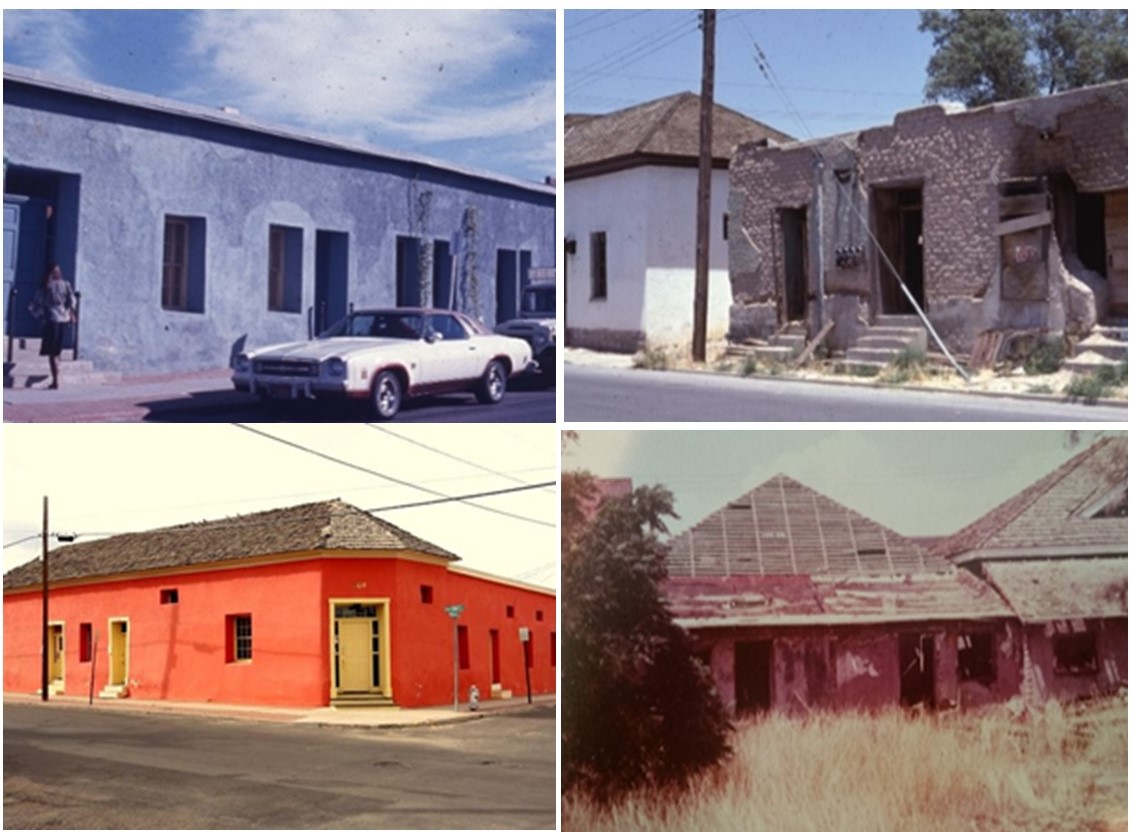
Prior to this date, during the Roosevelt’s WPA of 1935, the City had installed all new cement sidewalks, which improved the old, dilapidated Barrio substantially. Additionally, many old adobe homes had new, pitched, corrugated tin roofs, or rolled asphalt gabled and hipped roofs installed to replace or protect the old, flat, dirt roofs and adobe walls.
Around 1966, nine years before I arrived, through “urban removal”, a city plan had resulted in the demolition of eighty acres and the uprooting of twelve hundred people to make room for the new Community Center, leaving behind a cultural scar in the rest of what was practically a forgotten and ignored area. It would take more time, but the City could expect a similar effect for the rest through ‘demolition by neglect.’
When I got there, a new and small but growing awareness of historic architectural value in the area was beginning to take hold. Nevertheless, five to ten empty lots had undulating dirt or barren ground where an adobe house had once been.
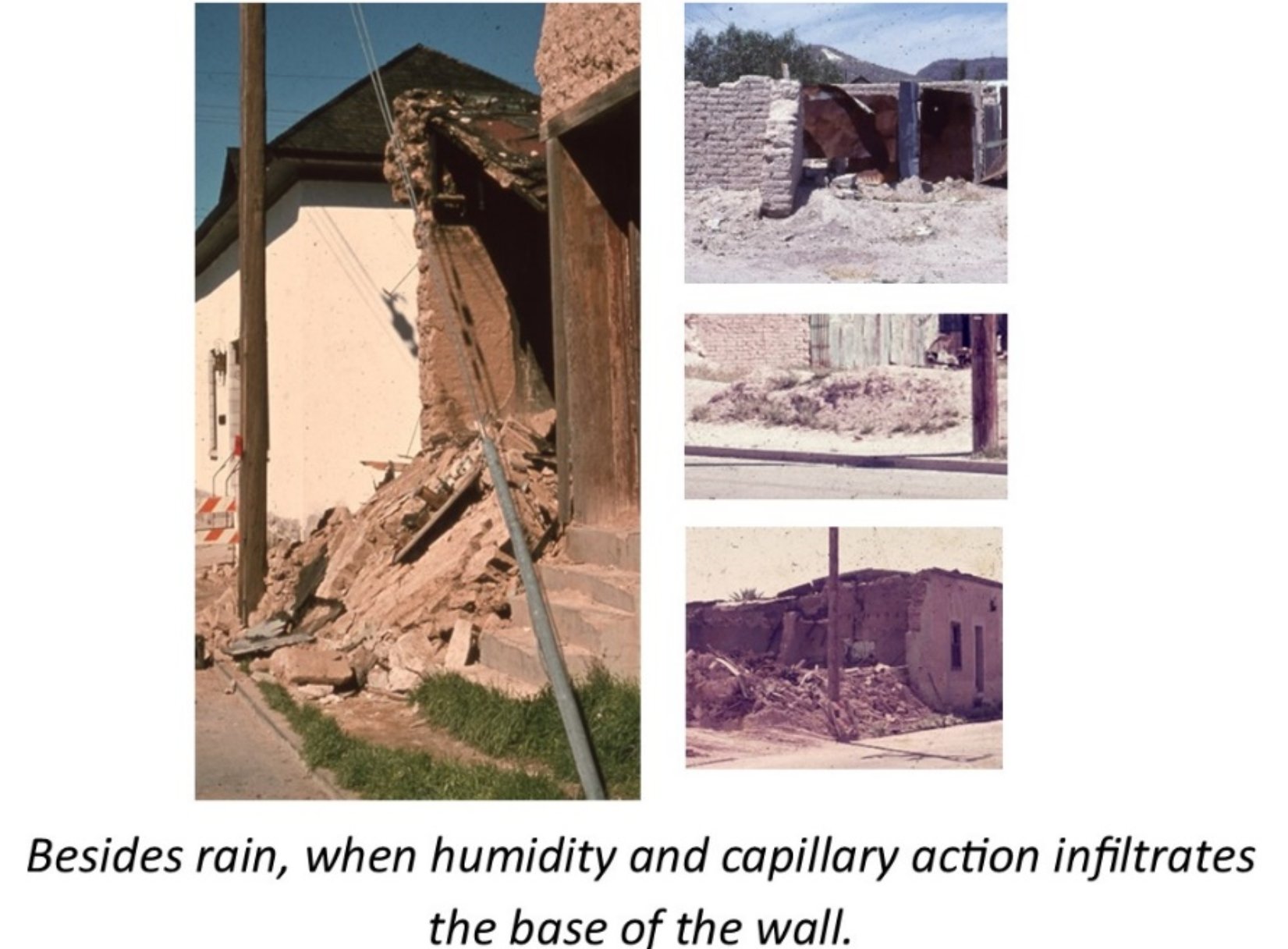
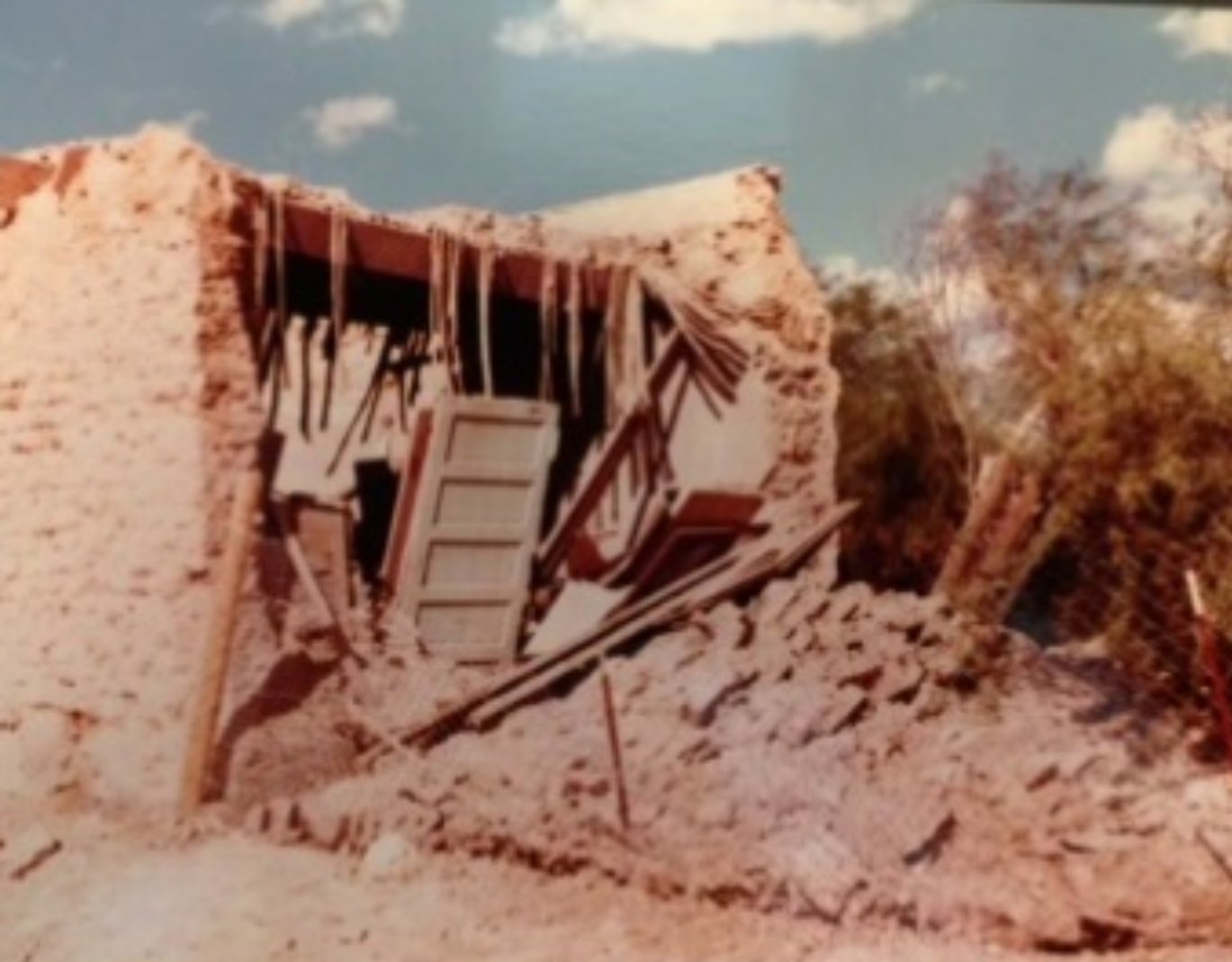 The old houses had melted and washed away by the rain. Three or four lots had walls in different states of deterioration in the process of melting down to a mound of dirt. Many vacant structures, maybe one or two per year began the process of collapse starting with ten years of leaking roofs and then moving to three years of crumbling walls, and in a year or two returning to barren ground. Thus, the immense value of the corrugated metal roofs that were added to many of them to save the adobe below.
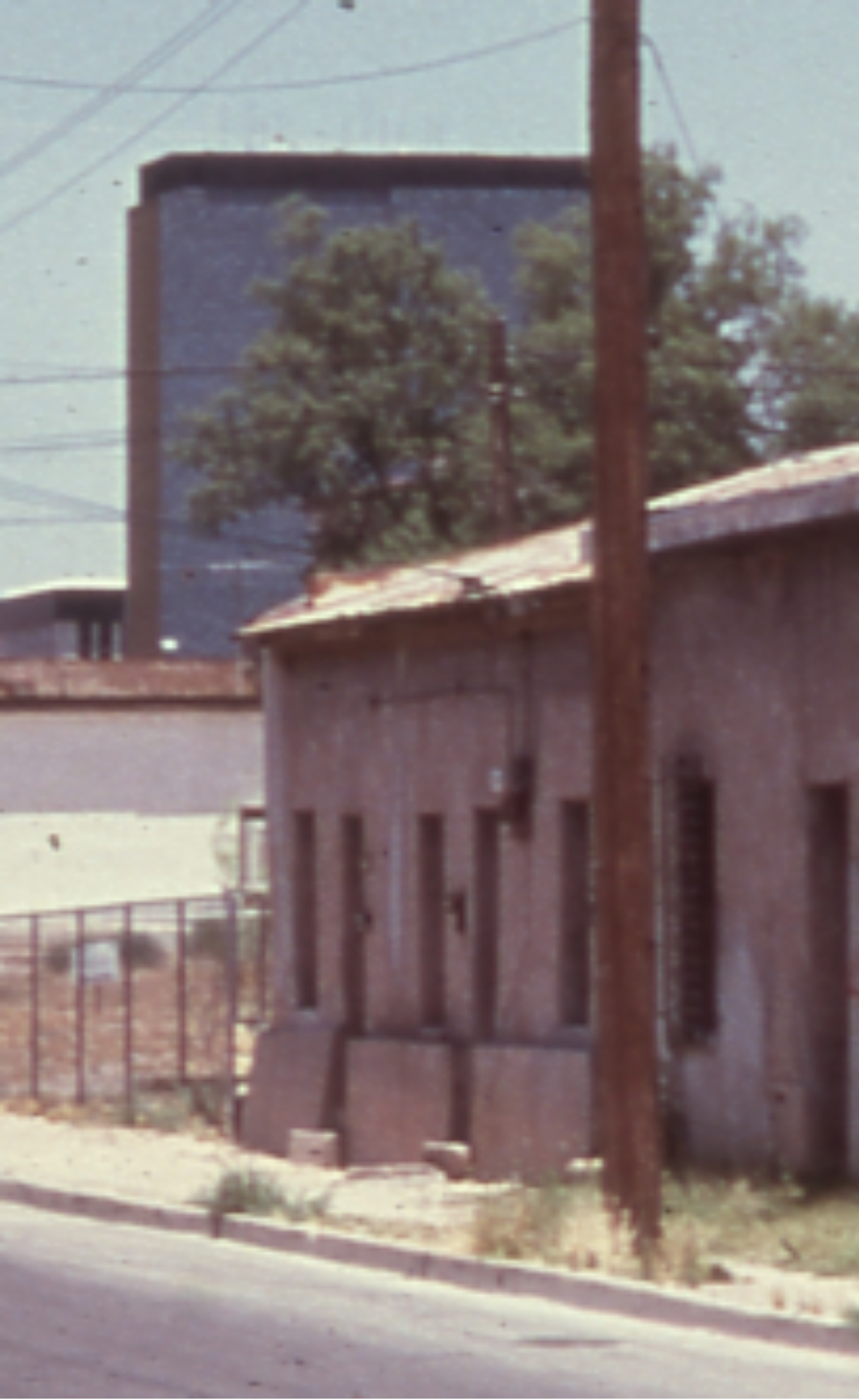
For buildings that have lasted hundreds of years, if well protected, it’s a matter of just a few years before it all turns to rubble and finally dirt. Also, through capillary action out of neglect, humidity from standing water at the base of the adobe wall can be absorbed from the bottom up, eroding the base of the wall until it dilapidates, evolving from solid adobe to lose dust. Without its supportive strength, the weight from above causes a collapse. The following pictures illustrate what happens to houses when roofs leak, walls collapse, and buildings come tumbling down. The wood deteriorates and the result is a mound of dirt.
It didn’t take long before I began to clash with my peers and my boss. I clashed with my peers because of their laziness and lack of creativity and with my boss because of more subtle ideological differences which emerged very slowly.
“How is the house plan for Paco coming along?” Jodi asked me. Paco, a low-income client received government help.
“Easy”, I answered, “I took the information you gave me to design the addition to his house. After wanting his room on the back, away from the noise of the street, he called to ask that his bathroom have a tub and a separate shower. This is not possible for lack of space with his room in the back.”
Jodi looked at the floor plan.
“Tell him ‘no.’ It is ‘either or’ and you have spent enough time following his fancy.”
“I’ll call him to explain. Maybe he could do with a smaller porch.”
“If you ask him, he will keep changing his mind at every turn. Don’t call him. Finish the drawings, and let’s move on.”
After Jodi was gone, I called Paco.
 “Skip the shower,” he said, ‘”but I would like to have more space in my living room, and, can I have barrel clay tile roof instead of asphalt shingle?” On this one, Jodi was right, Paco would not let go.
At one time, Jodi was giving a presentation to the staff about previous projects his office had been involved with. I must admit that he was good! With minimal resources, he had accomplished quite a bit. Some of his ideas were brilliant and his contact with the City officials was smooth and effective. Two of his permanent staff, including his office manager, were previous VISTA volunteers. He treated everyone with respect, or so I thought. I thought I was ready to learn a lot from this extraordinary man, and I paid attention to his project.
Trying to do right by the Native Americans in 1964, Congressman Mo Udall was working on passing a bill through Congress to transfer the title of 202 acres of land to an Indian tribe, and Senator Dennis DeConcini was at the time working at the state level for the Pascua Yaqui Tribe of Arizona to be federally recognized. At the time, the Papago Indians, which is now better known to us as Tohono O'odham Nation, also had a large reservation south of Tucson including the Mission San Xavier del Bac. As with many other Indian groups, there was a policy of assimilation but not a goal of full participation.
Houses for Indians were often in limbo while reservations were trying to transfer to independent nations and/or obtain other types of federal recognitions. These were very difficult propositions, and Jodi had somehow navigated through all the hurdles and bureaucratic jargon. While showing us some slides, he explained, “In this project, I designed and supervised the construction of nine houses for a group of Indian families. We got federal funding, and I studied their needs and their culture. This arrangement or reservation, as you all know, is inside the city limits, surrounded by other houses, so we built a wall around the complex to give them a sense of tribe.” The actual details may have been slightly different.
One of the other people present asked, “Isn’t the kitchen a little bit small even for a regular house? Don’t they like to cook?”
“Oh, yes. They like to cook, but I did this on purpose. The women in this tribe are all slaves to the kitchen. They all gather in one of their houses and spend all day in the kitchen preparing the men’s meal. I wanted to force them out and have them go free from the kitchen, get a social life away from working to feed their husbands all the time.”
I didn’t think I was hearing this right.
“I can understand the encouragement to expand their circle of activities, but you are eliminating one of their key cultural traditions. What alternative do they get?” I asked.
“They’ll find one. Not everything in their culture needs to be good.”
Despite our general agreement on the free role of women, something about this attempt to impose his intellectual conclusions about what is a good role for women and forcing it on them based on his personal ideology, while selectively ignoring other parts of other’s cultures, did not seem to me to be proper or right, but I kept quiet. He was proud of his theory and there was nothing to be done about it, not at this time anyway.
I called Sofia, widowed mother of three assigned to me, who was getting assistance to add a new room to her one room house.
“Sofia, I am working on your new room, how are things going?” Immediately I regretted my question.
“My youngest child is ill, I lost my part-time work because I had to take him to the hospital, and they have stopped my food stamps because they found out about my part-time work. The alternator in my car is not working, so I have to walk to the hospital, and my swamp cooler stopped. I can’t think in this heat.”
Feeling her pain, I mumbled my sorrow and told her I would get her the phone numbers to other agencies that could help her with other problems more acute than a new room at that instant.
“Chuck, we are not a social program.” Jodi told me. “We are an architectural office doing a service for selected clients when they cannot afford a regular architect. Let someone else handle her problems.”
“Who? Sofia can’t function as she is now.”
“It is not your role. Don’t waste your time, our time, with them.”
Who is the ‘them’ we are not to waste ‘our’ time on? I tried hard to find the logic in his argument. There was some logic there. I was not equipped to solve any of her problems and learning about how to do that job in a new city would take my time away from our goals. Besides, people need to learn to solve their own problems. Yet, if they are in a crunch, and drowning, obviously they need time and guidance. As we help, and how we help, often prevents others from learning, and builds dependency. What then is important to learn and what is better to leave for others to learn themselves? Some tools you use only once, while others, once you learn to use them, you will use them often. Should I and others strive for self-reliance and self-sufficiency as an important tool, or not? Since then, this critical question became a fulcrum in my thoughts. But an alien thought began to take shape in my mind. When someone wears out their mental energy just meeting daily needs, is there any energy left to change their situation?
“Are we going to have a chance to talk to the VISTA coordinator when he or she is here?” I asked him. I needed relocation money since I was broke. Jodi was generous enough to offer me a couch to sleep on at his house until I got my own place. He lived by himself. I never inquired about his private life. During the day, we had little time to raise personal questions.
“Yes, they will be back later during the week.”
A few days later, I had gone back to Jodi’s house to get my couch ready for the night, when late that night Jodi and a female VISTA coordinator came in and without a word to me, they both went into Jodi’s room. Next morning, I left before they did. The female coordinator was gone before I had a chance to ask my questions, and still with no money I realized I had to look for a different place to stay.