Painful Ineptness and Loss of Funding
The worst of all my misguided failings while I was in Tucson, much worse than getting hit by a boulder or running away from a fight or allowing a mural to be destroyed for no sufficient reason or any of the other reasonable or unreasonable events that took place, was my biggest and most stupid failure that took place during the defunding of the TBA at a City Council Meeting. I could have made the Barrio win all, in one last battle, in a decisive way, but I didn’t. I literally pulled a defeat out of the jaws of victory. All by myself.
The City staff was recommending to the Mayor and Council that all sub-recipients, including the TBA, should lose their administrative funding for lack of performance. They used the consultant’s report as support for their position. Some of the other sub-recipients had already become inactive and they had given up the fight. We had spread the word about the upcoming meeting with the City Council. The neighborhood rallied behind the TBA in large numbers of support. I counted 120 people at the meeting supporting us, many carrying signs and sitting together occupying a large part of the audience’s chairs.
When our item on the agenda came up, the City Department proposed that because city control could be more effective, the funding for all sub-recipients, and specifically that which the TBA was receiving, should return to the City. They cited the results of the consultant’s report and suggested that administrative funds be withdrawn, and no new funding be granted to the TBA, or any other sub-recipient.
I expected some comments from the Democrat Council Member George Miller, to whom we had given a personal tour, but he was silent and sitting smug.
At this point, let me explain that no governmental entity was allowed to use CDBG funds to start new residential construction. This meant that the City could not run a program in which new houses were being built. This meant that the City could not take over the Self-Help Housing Program, only the rehab and the administration funding. The TBA had title to all the properties, and the TBA had the construction financing loan that was more than 60% consummated. By taking over the administrative budget, the source of the payment for the interest portion of the construction financing loan, the City would inherit those interest payments, but they would have no say-so on the construction end of it. Now, if they got their way in defunding our administrative part, most of the interest on the loan was to be paid from the Department’s budget, while we kept drawing the construction money from the bank as needed. The bank required our signature, mine, and the City made the interest payment. Convoluted, but the ramifications of this complex situation will develop as we went on.
At this point, the construction financing loan had a provision for administrative costs that the families could pay with their mortgage, and not tied to the interest payments now paid by the City. I could then have asked the families for their consent and drawn an administrative salary. The families and the board would have agreed to it, either way this would have made the City’s action of defunding me moot, but I never did so.
Then the Mayor called for public comments. He stipulated that only twenty people would be allowed to speak, alternating the pros and the cons, for one minute each. I chose not to talk. This was the Barrio’s battle more than mine. Share the power. Besides, I had nothing to add to whatever others would say, or so I thought.
One by one each person at the microphone spoke their mind, pros and cons, developing a tapestry of words, adding color to the oral theater of that evening. The entrepreneur Randy, on the negative side, declared the Barrio was his new home and that the TBA was not helping him at all. Carmen on the positive side, as a longtime resident, said she and her children had been working there since the beginning of the TBA. She was building her house and supported the TBA. Rodriguez, the artist who couldn’t make ends meet and who’s car title I still had in my pocket, since he still owed me money - he never paid me back - spoke as to how he had been disappointed by the TBA. Panchita said she was proud of all the things the TBA had done. William brought up his Indian heritage and the prestige of his father, and said he wanted to have a Neighborhood Association that included everyone, and the TBA was not doing that. Bertha spoke up for the TBA and how she was born in the Barrio and the TBA had always included everyone, giving specific examples. Juanito did not speak, but his wife who was white, gave an emotional rendition stating how her husband, with no help from the TBA, had forged an advance in the progress of their home. She failed to speak of the grant they got and their misuse of the Tool Library equipment and personnel, in addition to the time when she hit me. Larry Lucero, by then Chairman of the TBA, spoke in its favor.
I began to feel uneasy. Something was not happening the way it was supposed to, and I could not put my finger on it. I looked around at the audience and was reassured to see all the people supporting us compared to the few that had gotten up to speak against the TBA, but I was still missing something! Our people were half of the entire room in attendance and the opposition was only a small handful, but something was very wrong. The most obvious is sometimes invisible. You cannot see the forest for the trees. I looked at the signs some of the people were holding. They were handwritten and diverse. “We support the Barrio” and “Barrio Viejo” and “Hurrah for the Neighborhood” and “We want City support”.
Something was wrong, very wrong. What was it? I had heard Randy talking about their misnamed group Neighbors United, and the echo kept bouncing around the hollow cavities between my brain and my skull. I knew that everyone who was giving a negative slant had already brought their complaints to the Commissioners. Therefore, there was nothing new there for them. No new faces and not a single new face got up to speak against the TBA. It was so obvious, but my brain was getting tied up in knots. I didn’t know why. What was also obvious to us, but not to outsiders, was that all the complainers were recent addition to the Barrio. Ray would have suggested, “Ask each of them how long they have lived in the Barrio. Not to denigrate them, just to be able to see things from the right perspective.”
At that point, Dave Parslow who was standing on the sidelines, came up to me and said, “You have to get up there and speak.”
“Too late. I didn’t take my place in line. They are doing just fine. Besides, I can’t take anyone away from their spot in the line now.”
“You have to speak! They need to hear you.”
His urgency kept reverberating in my mind. I knew he was right. He too could sense something wrong, but I didn’t know why. What more could I say? Nothing was said about all the accomplishments in the last five years made possible partially thanks to the supportive funding and the will of the people.
Bobby Galvez was the last in line and would be in support of the TBA. I knew Bobby very well. He was born in the Barrio and would do well. It would be a disappointment to displace him as a speaker. I didn’t even think then about asking him to share half of his minute with me. Here is what I failed to do, and I failed miserably. I still regret it. Here is where it would have been so easy to remedy and correct. I could kick myself until Kingdom come for my inability to see the obvious, when I did not speak. None of the Barrio people were known to the Commissioners, other than the ones who lobbied them, and that was me, Ellen back then, Bertha, Larry Lucero, and Carmen because she had always come to every Meeting. A total of five. They knew people wanted funding, but they had no way of knowing who in the audience was for or against the TBA funding part. Most of the signs said pro Barrio, not pro TBA. They had no way of knowing that the ratio was 120 in favor to 10 against the TBA doing the work. As things stood, by appearance to them, the group was split 50-50, with ten speakers in favor and ten against. Were they aware of playing a political numbers game? I wasn’t.
All I should have done in 30 seconds was to go to the microphone and turn to the crowd, and in English and Spanish request that “everyone who is in attendance for the funding for the Barrio to please stand up.” 130 people would have stood up.
Then, giving enough time to count them, continue in both languages, “everyone who is IN FAVOR of the TBA please SIT DOWN.” I could have added that if they were not of low and moderate income, to also sit down.
That would have left standing ten people or less, for some of those who spoke negatively were wealthy. Even some of them may have sat down out of embarrassment, but those I could have called by name and said, “You just spoke up against the TBA, please stand back up, unless you want to tell the Council that you changed your mind.”
I did not do any of that, to my eternal shame. I didn’t think of it. I failed to ask the key questions. The weight of such a mistake came crashing down latter. Obviously, I was not really qualified to be where I was. What gave me the right to get others involved in something when I was not able to expose the truth when it counted? Even if depression is a waste of time, I was caught by it for a short while. The only argument in my favor was that no one else had done it either. A Spanish teacher of mine would say. “Mal de muchos Consuelo de tontos,” or “The sorrow of many is a fool’s consolation” or “The misfortune of many is the consolation of fools” or “That many others are also mistaken is a consolation for dupes.”
The only council member who spoke up in our favor was the black Republican from another district. He said he admired how residents of the Neighborhood were the ones doing all the work. He found it proper and commendable. He voted in our favor. I have found, ever since then, that black Republicans are the very few politicians that have any integrity and who are usually motivated by righteousness and not by rhetoric.
The four Democrats voted in favor of the Department’s request and against the TBA, while now the Republicans were willing to vote in favor of the TBA. A reversal from the vote that took place seven years previously. Ray’s conclusion was that “Republicans believed in individual effort. Democrats believed in redistribution and collective hand-outs.” I thought he was crazy, but maybe he wasn’t. I thought that that while I was so busy taking care of the inside of the Barrio, I neglected the ‘lobbying’ to be done with the council members, while Dan Benitez and his people did a better job - not at building up, but a destroying. Progressiveness as regressiveness.
Much later I finished drawing up the chart of our project cost, included in the next chapter for CDBG funding, but not in time to show it at the Council’s Meeting. I wish I had. Including administration, rehab, the purchase of land and the Self Help Housing expenditures, our total was close to $500,000. Of that amount, 70% to 80% was spent inside the Barrio by paying salaries to residents of the Barrio, purchasing adobes made in the Barrio, plus using other Barrio resources. The percentage in salaries would circulate internally spent in Jerry Lee Ho’s Market and in local stores for personal and home needs. The Self Help Housing loans, the development value of the seven new houses, and the increase in property value to everyone by the new construction of seven homes, came from the private sector, adding $180,000 more or less on each. That is $1,260,000 of value into the Barrio. Only Republicans recognized the value of the resulting leverage of the funds, in such an exponential way, within the target area, which the City Department could not do.
Look carefully at the chart one chapter below when you get to it: to a Republican the money from HUD in both cases, ended up inside the City and initially that was enough for them, but they also recognized the improvement to the individual, which we had to prove, and we did. Then they recognized the value of the money circulating inside the Neighborhood as well. While the Democrats had no interest in the individual, they lost the value of appealing to the poor minority because that minority was working and no longer so poor. Democrats always refuse to acknowledge how economics really work. Only working through the City staff, could they keep residents under their influence. To them, it was politics, not economics. Now I could see why Ray had said that the newcomers, increasing in numbers, will have more weight as time went by, because they vote. And they did.
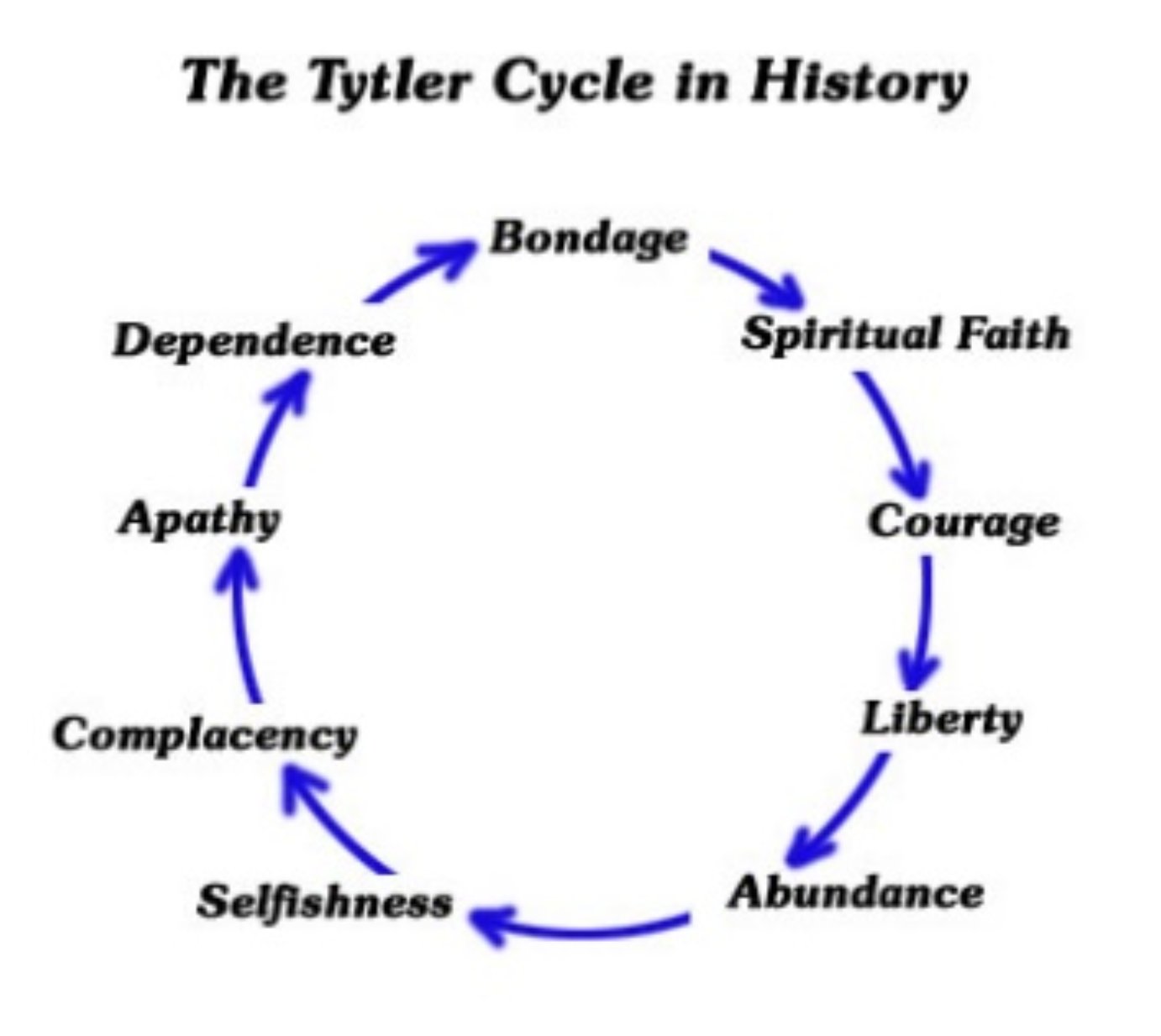 In the eighteenth century, Alexander Fraser Tyler, a Scottish professor at the University of Edinburg, is credited with writing:
"A democracy cannot exist as a permanent form of government. It can only exist until the voters discover that they can vote themselves largesse from the public treasury. From that moment on, the majority always votes for the candidates promising the most benefits from the public treasury with the result that a democracy always collapses over loose fiscal policy, always followed by a dictatorship. The average age the world’s greatest civilizations have been 200 years. These nations have progressed in this sequence: From bondage to spiritual faith; from faith to great courage; from courage to liberty; from liberty to abundance; from abundance to selfishness; from selfishness to complacency; from complacency to apathy; from apathy to dependency; from dependency back again to bondage."
Subgroup Struggles Individuals and the Collective
Amazing how some people can predict the future.
Re-read the quote carefully and look at it from a new angle this time: Look for a clear road map on how to exploit the weakness of a democracy if you want to replace it with something else. “Give people handouts.”
We had to prevent the people in the Barrio from ever failing into this sad predicament. While I agree with the possibility of this prediction, I don’t agree with the inevitability of such a vicious cycle. I do, however, see the danger in discovering that you can get yourself snared by money from the public sector and the misuse of that money for also buying votes. We see that today with politicians, government sector unions, welfare entitlements, proliferation of government intrusion into social programs, education, health, etc.
The great defense the United States has is the Constitutional Balance of Powers. Still, there are many pitfalls to be aware of. Is the United States vulnerable to this cycle? Tipping the scale over 51% votes for welfare handouts will destroy democracy, a democracy that has just passed the 200 year mark.
Historically, Republicans have failed miserably in educating the disadvantaged on how the Republican ideology can be beneficial for them, while the verbal rhetoric of the handouts offered by the Democrats is more effective.
The economic cycle of buying votes by promising and giving freebies to those that vote for you is habit-forming and pulls on emotional strings. The government increase in social programs is a very dangerous trend, impossible for politicians to reverse funding these programs, Democrats or Republicans, and not lose their next election. This trend leads to the
Government Deplorable Cycle
How hypocritical am I? Here I am using government money, not for a social program, but for a rehabilitation program, but still, a dangerous slippery-slope, and criticizing the government funds I am using. But it is not the tool; it is how it is used and for how long. The role of the government is not to engage in social restructuring. That is the role of the people. Therefore, to not fall into this trap, it is imperative to have the Barrio free from government funding as soon as possible, and I would not fight too hard to prevent the TBA’s funding coming to an end sooner than expected. Good! Or mostly good. My depression was not caused by losing the government funding. It was due to having let the residents of the Barrio down when they could have had a victory, a public recognition from the Council for their effort.
With feeble and apathy people hoping for change, the idea that a strong government is better equipped to correct inequities has been gathering momentum. However, to survive, the strongest must prevail, the good 20% strong must lead the way doing two things: A) Empower and educate the weak, and B) control corruption. Clean house first.
Surprising parallels exists between what takes place in the Barrio compared to what takes place at the national scale
Fake ideologies. Our foreign policy, handouts to other countries, is fully permeated with corruption, many of our own politicians get kickbacks from the aid we give to corrupt countries, - given with the false intent to induce them to purity, there is no attempt to trace the money. It is so obvious, and people don’t see it. And good politicians do not act to stop it.
Let’s explore some similarities at the national scale. Are the forces encouraging this Government Deplorable Cycle doing it on purpose, or is it unintentional? Could well organized groups be by intent pushing the system to provide more and more freebies to weaken the social and cultural fabric? Which groups? And what are they gaining by doing that?
Those that want to take from the very rich and give to the poor masses are in search for power and money. Minority groups with federal funding lose their original mission rather quickly. The disfranchised, the greedy, the radical by profession, ideological judges, the racial pimps, and others pull in what they think is a joint effort, while those in power keep most of it: power and money. Look at it from the top down. Mussolini, Mao, Stalin, Hitler, Castro etc., all are on the extreme right or the extreme left. Common for all is they never suffered the misery of their country. To them, the poverty of others is a source for their economic wealth. You may wonder, and complain, that I keep using the same names of dictators to prove my point. However, the hidden message is that those dictators were not obvious as they were moving up, neither are today’s enemies from within.
In a free economy, the competitive rich do not want to keep others poor. The reverse, it is to heir benefit, to see a growing middle- and upper-income class and no poverty. There will always be, and ought to be, entry-level jobs. The idea is not to claim that the middle class is perfect, but the more people in the middle class, the less numbers suffering in poverty.
Democracy is based on the rights of the individual. Once you emphasize the collective, you begin to kill democracy and pave way to dictatorships. The collective belief is that ‘we’ as a collective, not ‘I’ as an individual, can make things better, In the collective, the “I” includes “all others,” and “all others” includes “I”, So when it is said “it is owed to everyone,” it means “I am owed”. When it is said: “I get taken care of,” it means “It is my right to be taken care of” which means, “I am entitle to it.” Thus “I am absolved of personal responsibility because it is the collective’s responsibility, and I am allowed, even encouraged, to be arrogant and intolerant about been irresponsible.”
Maybe Ayn Rand said it better than I can when she said, “Collectivism — the idea that individuals should be subjugated to the group and sacrificed for the common good — not only is a moral evil but is the essential cause of the political evils engulfing the civilized world.”
The collective thinking advocates that everyone is entitled to shelter and freedom from hunger; altogether a very appealing proposition. It is only when in the Tyler’s Cycle of History the population has gone through “complacency” to “apathy” and then “dependence” that true selfishness sets in. They deserve it. The selfishness of the individual is less valuable than the selfishness of the collective. None must be hurt, even if in order not to hurt one, you hurt many others. Who declares the winners and losers? This is powerful but crooked reasoning, and because someone must decide what is best for the collective, you must have ‘the Estate’ do so. The self-appointed Elite, who control morality, the dictatorship who distributes wealth, notice they never distribute their own wealth. The Islamic mullah who through Sharia Law tells everybody how they must live. Sharia law forbids insults of Islam, insults against the Prophet Mohammed, or the recognition of any other religion besides Islam. In the USA, we are heading in the same direction. Political correctness will determine behavior to be controlled by the party in power. Decisions by someone else, complacency leads to absolution from personal responsibility. The goal of the dictatorship.
As Europe expands their need for power into ‘internationalism’ and ‘globalization,’ we experience that the global collective is promoted funded by a global tax where everybody’s money goes to feed globalization. The goal of the dictatorship. “…and clothe it with moral garments” and #11 “Goals must be phrased in general terms like ‘Liberty, Equality, Fraternity, of the Common Welfare, Pursuit of Happiness, or Bread and Peace.” In other words, deceive, deceive, and deceive, and make it look holy. Where have we heard that before?
Individualism, on the other hand, requires responsibility for self and others. Biblical teachings advocate you must always follow your own individual conscience for you are the only one who is ultimately responsible for getting yourself into heaven. This way of thinking causes the Catholic Church to be an enemy of globalization and therefore those who want control must get the church to convert to collectivism. Get them to think that salvation should no longer be individual. It must be in the collective, and if this ever happens, if churches ever promote the collective salvation, we are in trouble, because there is no stronger force at present in the world than this church to prevent the elimination of the individual integrity. Our only hope would then be on some of the remaining Christian churches and maybe also Buddhism. .
Success or failure in turning around this Barrio was to be based on a clear understanding of the forces between individualism and collectivism and in the need to protect one from the other. Failure to see that will drown any attempt to positively organize any group. If I made the wrong decision in whatever influence we may have had, the existing Barrio would become more dilapidated, physically and culturally. Saving the historic characteristics of buildings was relatively easy. Saving cultural and physical characteristics simultaneously was a challenge, and it would be based on the power and the freedom of the individual to continue to express his culture in peace and tranquility. The enemy that would ensure its demise would be the collective mentality, for the collective cannot pull itself up by its bootstraps. It’s physically impossible, try it. Teamwork requires individual effort.
According to Alinsky, to win you must demonize the existing structure, then when you have created a new one, it becomes subject to be demonized as well. Call it Black Nationalism or La Raza or whatever may sound good as a replacement of something you don’t like, but will it be an improvement to others? For them, maybe yes, but for others? If we want real change and not selfish change, this approach must be avoided. The organization ACORN tried to demonize the police as abusers. They wanted to eliminate authority and replace them with social workers, as if that would improve the quality of life of the Barrio people. Badmouth the police, then replace them. The more modern interpretation of social justice tries to group all discontent groups together, but the one group that wins the most is not going to keep the others together or remain together with the others. They will want control. If all of them were to win together and stay together, then you have America, which is what we want, not what they want.
To the three basics of Pride, Family, and Hands, perhaps I should add Individuality. I think my emphasis on the individual is innate, but I wondered and I asked Ray,
“If a political or social movement, when new, does not share the power with each individual as individuals, instead of as a collective, will it be destined to failure?”
I was surprised that he agreed with me, and even more so on how.
“This thought you have turns the meaning of leadership on its head. Leaders are important, but they can also be a detriment, since leaders in the form of “el caudillo” are a subjugation of individuality to the one individual who controls the masses or the collective. There are different types of leaderships: supportive, unobtrusive, authoritarian, or charismatic, and that makes a difference. Charismatic leaders tend to be erratic and incompetent but still manage to look good. It may be rare to have a charismatic competent leader.
Leaders in communities should lead by example, an example is to be emulated. That’s sharing power rather than having people look up to the leader as the only one with the answers. We need to learn to be our own leaders first, then to learn to work as a team, by choice, not blindly. It takes work, and who said that democracy was easy?
Democracies work by the vote delegating specific responsibilities to government not by divorcing from all responsibility, as we hand out our control to others. When group democracy is accomplished, subgroups are no longer subgroups. They become equal groups with their own agenda working in teamwork with the mutually prevailing culture toward same goals.
Each group needs to be forever vigilant from being vulnerable to false self-serving leaders. Sharing the use of power is not just to overcome what you don’t like. It must include building up a better alternative, a replacement. The adjective “better” is the operative word. Jerry and Jose were a help when I was tearing down adobe walls, that was easy, even intuitive, but construction demanded education, hard work, practice, skills, and the risk of failure. That was harder and therefore easily avoidable. Alinsky misguided Rule #2 would say: “take Jerry and Jose and don’t go outside their experiences, but give them more power for tearing things down, and don’t teach them to build things up, it takes too much effort, and you lose control, so don’t do that!”
Alinsky was so wrong! Did I learn the lesson to ‘build up outside of their experience’ with Jerry and Jose while working in the Barrio? Barrio kids were good at ‘building things up’ only among their own cultural environment. Outside of it, resistance was shown by not cooperating, not participating, not volunteering. Assisting them to get outside their limited expertise is precisely what needs to be done. If we prevent corruption in all undertakings, Christianity has much more to offer than communism, and capitalism has much more to offer than socialism, but it does take hard work and a basic level of the individual social justice as mainstream. This can only be achieved by a conscious effort to work at it.
I have the uneasy feeling that the person in the Civil Rights era that understood this concept was Martin Luther King, Jr. Not so much those after him; many never got it. Without evidence, I also believe that Apache Cochise also finally understood this concept in his later years but was unable to pass it on. Some leaders in the civil rights movements continue to fail because they lean towards socialism, which is a hand-me-down system, trickle from the top down, “I can’t do it by myself unless someone gives it to me, after they take it from someone else.”
Instead, to end in a positive note:
“Ask not what your country can do for you, but what you can do for your country.”