Whereas with the City doing the housing rehab, not a single dollar in cash would enter the Barrio. With the TBA doing he rehab and self-help housing, over one million dollars in cash legally entered and circulated throughout the Barrio.
Chart of 500,000 Trickle Up Rather Than Trickle Down.
Of all the concepts in this narrative, this chapter is the most basic of all. Here is only the first step in the necessary economic cycle everyone should learn. A salary position is the basis of a productive society, the first step to economic freedom. The second step, not for everyone, is ‘investing’, which is not taught in public schools but should be. It requires delayed gratification, some sacrifices, and some risk, but the result can be economic freedom. It is part of the Trickle-Up Theory certain ‘leaders’ don’t want you to know. Part of investing. is the third step, also risky: entrepreneurship.
How much of the HUD money would have been spent by the City before reaching neighborhoods, or trickle down (top chart below) and how much money entered the Barrio and was used inside the Barrio, as a sub-recipient, or trickle up (following chart).
THE $500,000 figure used here for the CDBG Rehab Program funds as a round number. I don’t include the first year’s funding where the City prevented us from doing any work, or the intentional delays and handicaps along the way. Build an infrastructure from the start is more costly than continuation of projects. To help do so, other public and private funding is healthy, such as the Tool Library, private, and the Adobero Yard, a public start-up becoming private self-supporting. Bank loans, all private. Not all the funds requested were released, thus future requests were made, but not all used, for the City took some of it back. All the projects support each other. The City claims a much smaller % in their ‘administration’, but much of it is smoke and mirrors. Either way, it did not go into the Barrio. because of the complains of a few, all newcomers, and the lack of vision of our City leaders, - or my failure to communicate.
We had the kick-start that we needed, now we could have continued
without any government funding by utilizing the energies and knowledge gained. We were cut off right at the point of archiving self-sufficiency.
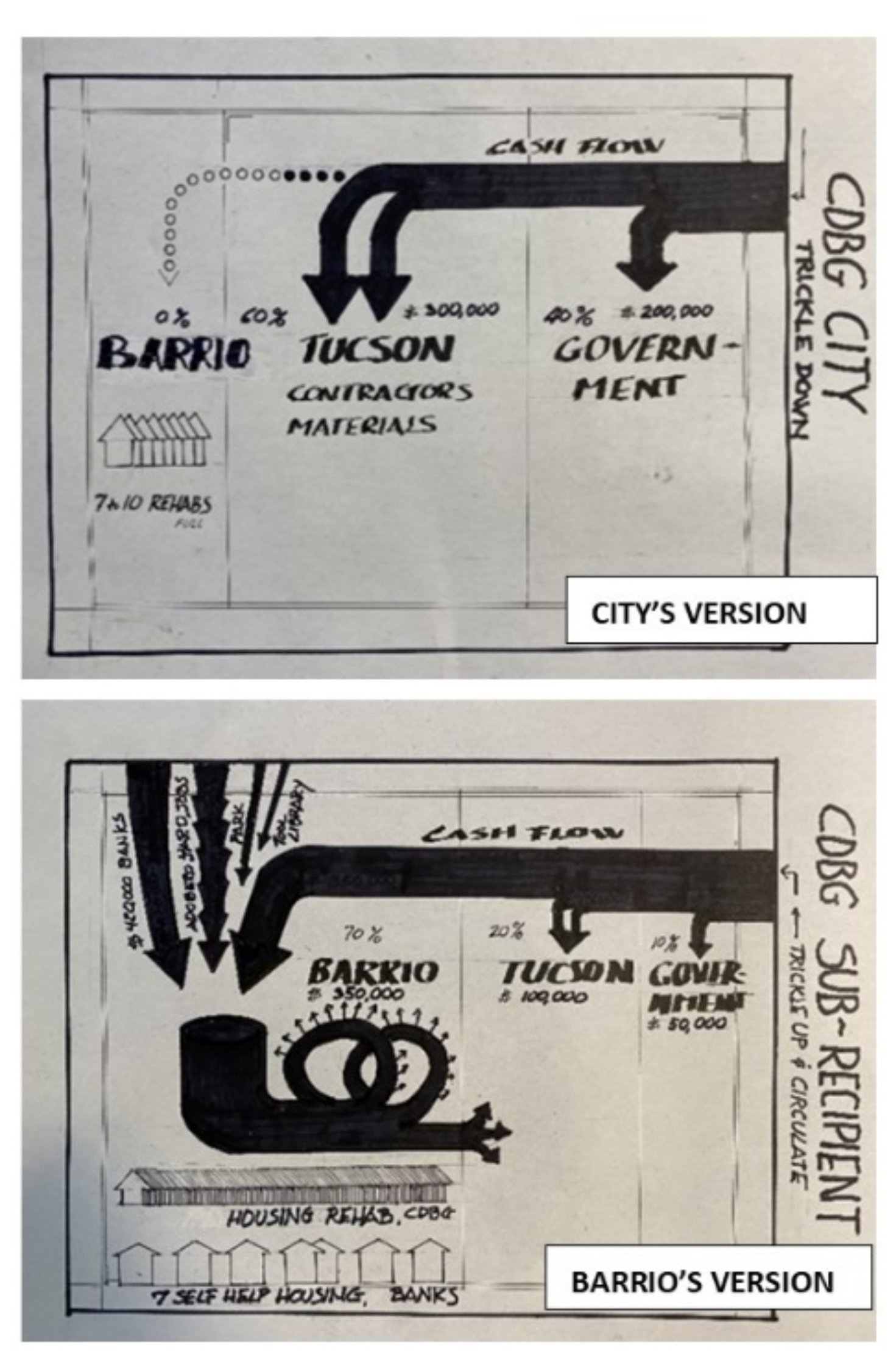
EXPLAINNING THE CHART: Rounding up $500,000 enters the City of Tucson from federal HUD’s CDBG Funds earmarked to the Barrio project. TOP CHART: If the City were to administers the Rehab Program, close to 40% of the funds would stay within the City Department in creative ways besides administration, called project implementation: for administrative, rehab specialist, accountants, and a percentage for administration, such as the director, secretaries, equipment, more inspectors, consultants, etc. The rest will go city-wide to contractors and materials, some of it for taxes.
An estimated 8 to 10 houses would be rehab, elevating slightly the property value. A total of $0 cash would enter the Barrio. Remember what
I was told when I got back from Texas, “We found no qualified workers”. With the City doing the program, out of half a million, the Barrio would get $0 in trickle down cash from a government program. See how the rich keeps getting richer?
With the Barrio as a sub-recipient, BOTTOM CHART: With good judgement and leverage up to one million dollars circulated inside the Barrio, making of HUD’s $500,000 a real investment. Here is how: the City Department keeps a small 10% amount for supervisory duty, stipulated by HUD, not by the Department. Some material, such as wood, cement, cabinets, and two staffs’ money go into Tucson at large. The rest from then on percolated directly into the Neighborhood and much of it circulated several times within the Neighborhood: workers’ salaries, staff, materials, all the adobe, consultation, tools, etc. All of it beginning to trickle up, increase, and multiply. Purchases at local stores, for instance at Jerry Lee Ho Market keeps the money flowing in the local community. With the Self-Help Housing project, federal funds were a catalyst, the lending was private funding leveraging federal funding at a rate of 8 to 1, the labor - sweat equity - was local, increased real estate value, even more property tax revenue for the City, families self-worth multiply, and other lateral benefits. It all dove-tailed beautifully with the Tool Library, the Adobero Yard, and skill training efforts. This is a case where HUD money was really “invested” in the Barrio and leveraged. The seven houses were the first private homes built in the Barrio in recent times, and they opened the door wide for more to come. Proof that we were no longer in a dilapidating neighborhood. The human gains were significant and magnificent. In this case, the sub-recipient system was by far superior to any other use of CDBG funds, for the purpose for which they were intended: home repairs, jobs, and training for people of low and moderate income. This is how individual effort benefits the trickle up.
Overall, the lack of attention by Republicans was maddening, except the wiser Black Republican. Republicans should have fought harder for the principles they claim to stand for, but they didn’t. Shame on them.