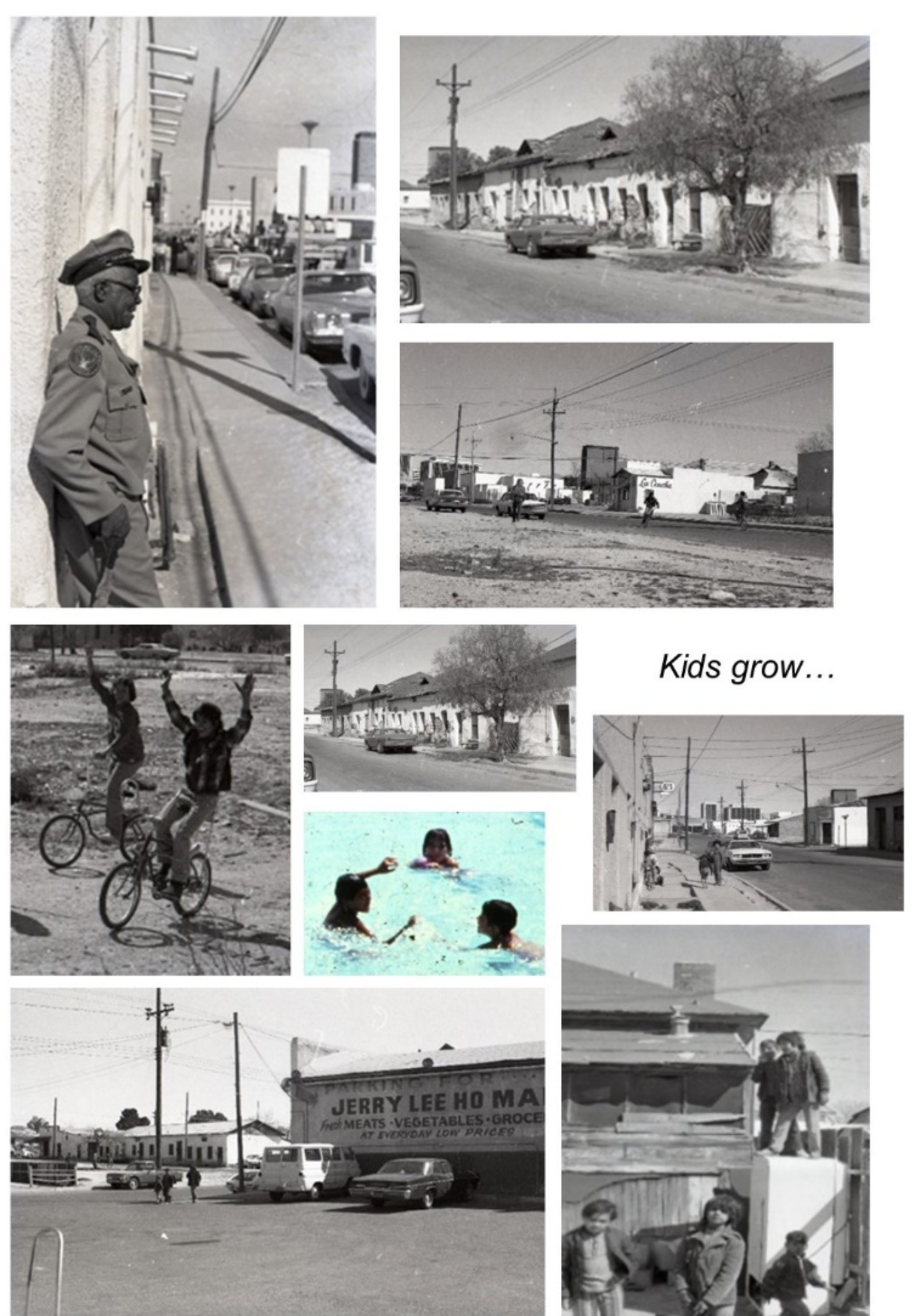
The Psychological Influence of Architecture
People who think that a ecology is what affects the poor are barking at the wrong tree. Family strength is the foundation of a community and determines the health of a society. Without it, the health of the planet becomes secondary. More immediate and critical than ecology is the psychological and environmental erosion of human values.
Adobe. The Power of the Barrio
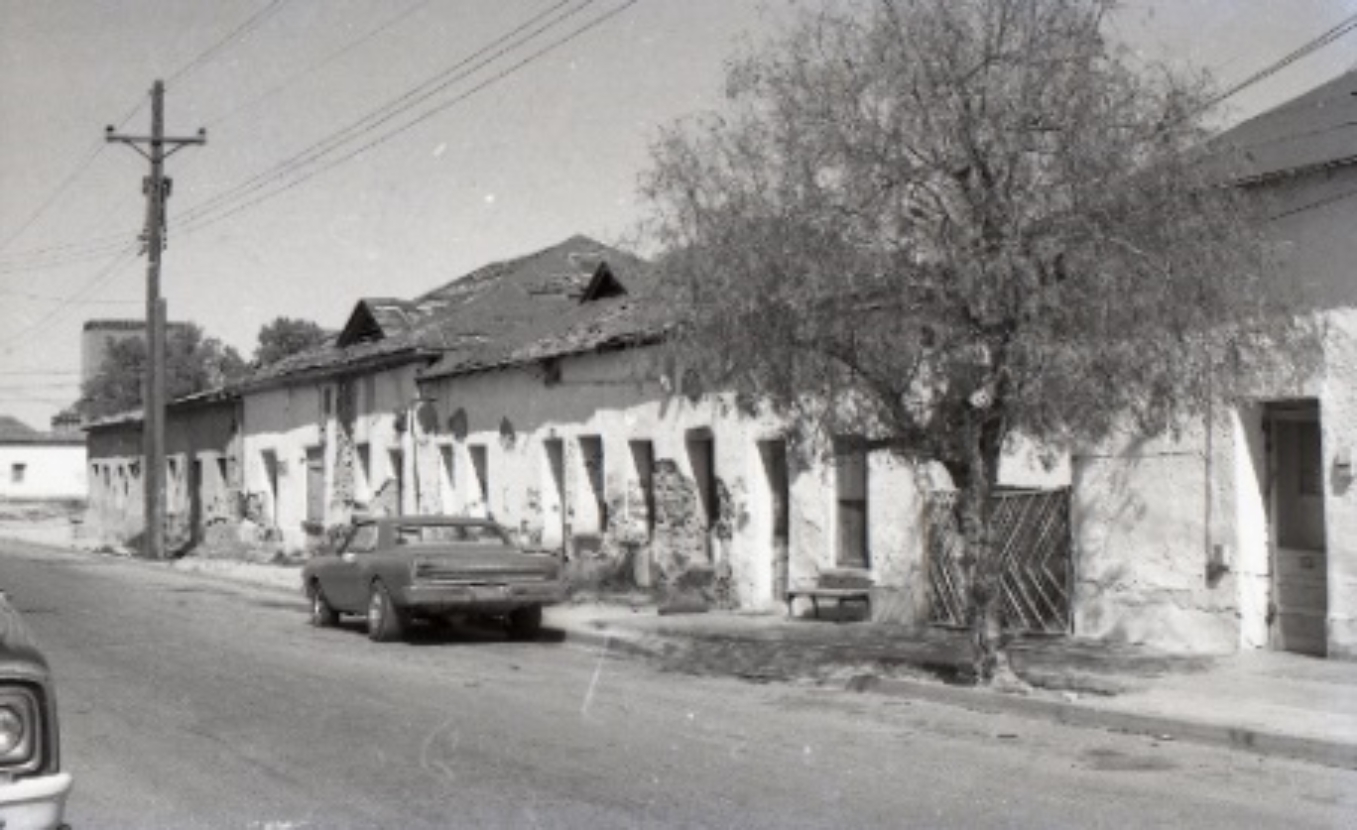
To the untrained eye, looking at the Barrio’s row houses from the outside, it is very difficult to tell a Zaguan from a row-house. One of the beauties of the Mexican tradition here is that there is no display of public ostentatiousness. People’s status in the community is known through other means. While walking along the sidewalk, you experience a wonderful melody enhanced by the essence of adobe and the rhythm of window, window, door, window, door, door, window, window, window, door, etc. The tempo of the music changes, and if you are sensitive, you feel it as you pass by. It is reassuring, pleasant, and very human in scale.
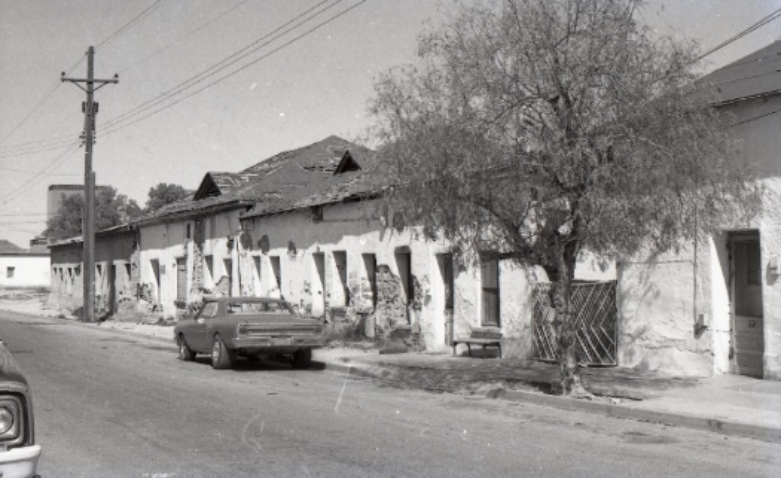
The door to the Zaguan, as compared to a Shotgun, would have a slightly more elaborate headboard, and the door opening may be slightly taller. However, those may be the only clues to those who know. Those from other regions would miss the signs.
I will not dwell here on the preservation of architectural style in minute detail, not fitting. Adobe must be felt, not verbalized.
In addition, we were restoring, not altering, the structures, which makes a difference. It was more pertinent for our purpose to focus on form and function, or aesthetics and practicality, rather than on specific style, since there were not that many. Whereas I strongly believe that historic restoration and preservation has value, I also believe that the value and purpose is only for those living today, and for the future, to learn the lessons of the past.
Too much purism begins to have a negative impact on the present. When function changes, like a car for a horse, certain forms may lose pertinence. We must deal with this issue here, as we change the form, we may lose the lesson from the past, but then even within a Hispanic culture, or any other culture, there is need for progress and change. If changing the form changes a tradition, then more conscious care needs to be taken. More so when it overlaps, is assimilated by, or is subdued by, or needs to co-exist with a second and third culture. The exact nature of these differences forms part of the potential displacement effect.
In the case of the section called Barrio Libre, at the time of this narrative, over twenty percent of property ownership had been sold or abandoned or reclaimed by mostly Anglos, many of them young. Many were still rented by absentee landlords to tenants of all income levels. As much as many of us would like to maintain the purity of the vernacular architecture, absolute purity is not advisable, you cannot freeze daily activity in a time protected capsule, except in a museum.
Those of Hispanic culture, and others, must recognize that if they value what they have, they must fight for it economically and legally (zoning, enforcement, lending, and technological fronts) not by colliding, but by gaining respect and support for the true value of what they defend and the knowledge and technology to maintain it. That knowledge must be both of their own culture and of the prevailing culture. Not knowing the other’s knowledge can wipe you out.
One way that so-called minorities are prevented from reaching economic independence is by the use of false ‘entitlements’ and other condescending ways of making them feel like second class citizens, like children who need special attention and permission. There are those who gain by keeping groups of people subdued do this by calling them “minorities” or “Mexican-American”. They are not Mexican Americans. They are Americans, equal to any other citizens. If you need or want to profile them further, you can add “of Mexican descent” or “African descent” or “Italian descent”, or better still “Mozambique descent”. There are hundreds of totally different African countries, etc. Whatever, but stop the shenanigans. Don’t let yourself be divided by being labeled “Something-American,” as you will then easily be ‘divided and conquered’. Your diversity, not the narrow-minded diversity imposed on you by others. Once a citizen, with an oath of allegiance to the constitution, every American is as American as the next guy. It doesn’t dilute you. It enhances you. Fight for it. It may take some time to learn how things work in the American culture, but it does not require to dilute your own, only to respect other’s. No more calling anyone a “minority.” It is intended to be demeaning and divisive. By definition, as a “minority”, you will never be treated equally, never ever, even if you become the statistical majority, because the powerful who called you so didn’t do it intending to give you equality.
What does all of this have to do with adobe restoration? To be seen as a ‘minority’ is speaking sneeringly about a culture. As a minority, a person is marginalized. As equal American no person can be conquered, even when retaining the values and respected of the Hispanic culture. Millions have done it. Millions will do it. And happiness follows. Keeping and maintaining a home by choice, is part of independence and freedom. The right to personal property is the foundation of democracy, capitalism, and the USA.
The TBA promoted full force home ownership: cultural, historic, ownership. How many ways can you divide a country? By promoting different languages, separating the families, creating diversity to prevent unity, pretending to promote equality but calling those that do not agree with you deplorable and ‘unequal by nature of minorities’, and devaluating personal property ownership with regulations, etc. Further create anger and resentment with issues of race, class, wealth inequality, religion, gender. The more issues clashing the better. When the Hispanics become a majority, they will divide the Hispanics into fighting each other subgroups of which there are many, while promoting further diversity, a never-ending game. Arrogance and intolerance. Are we finding this to be more prevalent each day?
Perceptions of the term ‘historic’ differ. To the Anglo culture, the value is in the historic quality because it increases the property’s economic value. This was Chris Delaporte’s argument. While to the Hispanic culture, the value is in the Spanish cultural ancestry and the pride that it expresses, the living environment, and respect for tradition. Both views have value and can be nurtured under the American culture preserving as possible form and function, the historic value of a structure and the surrounding environment. At the end, whoever understands the ‘legalities’ and can afford the cost will retain ownership.
Out of nowhere, Ray asked me a question seemingly out of context.
“Are you in favor of punishing a school child for speaking Spanish?”
“Of course not. Never discourage a child. Encourage the child who will have an advantage by speaking two languages fluently, or three. Explain naturally that in this country, in America, good English is necessary, other languages are arrows in your quiver. Youth is the best time to learn.”
When the Hispanic and Anglo function differ, then form (or floorplan) will be modified in different directions. I began to do it myself. In the United States, in the long run, economic worth will trump cultural value almost every time, unless you have both. How much can the Anglo modify architectural details to fit his cultural lifestyle as is the right of every property owner to do? Historic limitations to restorations are going to be imposed by the prevailing legal and intellectual class. The rest needs to be personal. Thus, here is how the TBA went further into the future. This is how we got away with it, by using the same three elements: 1. the economy, 2. the technology, and 3. the law.
Using all three made it possible when the City’s Department of Human and Community Development tried to harass and delay us by claiming that we could not do rehab work without the State Historic Restoration approval. We told them they could not stop us on that issue, only the State could do so. The law. They had tried to stop our work while up on the roof, and after failing to try to stop us from filling the warehouse with materials, and then with inspectors[xliii]. Then they tried to use legalities by calling the State on us, but we also called the state office, and as a result the State of Arizona sent the TBA and the City a letter saying that since we, in the Barrio’s Association, knew more about adobe restoration than the City did - technology - they would let us lead the way. We could do our rehab and new homes and they would inspect and approve them after the fact. I knew enough to know that I was not the one with that knowledge, but the Barrio was. Remember, the ‘historic” value due to the original function could best and maybe only be truly preserved in valid form by those of the same culture, and made adaptable to today’s living needs, because culture will affect architecture. Despite a training in architecture, my only part in this, while holding the purse string - economy - was to allow those that had the century old expertise in adobe construction be the ones that guided our group, since they had the technology. By then, we also had the rehab crew in training with their desire to learn and the capacity to begin to do it properly, pride in their past, but the kids were also part of today’s modern world, and they were going to live in those homes.
I repeat, only those from the same culture, the desert Hispanic culture in this case, using their mix of modern legal, economic, and technological tools, could possibly do a truly historic restoration for today’s Barrio world, and its use of enclosed and open space. I hope you notice with me that I am including here a basic element that is missing in most of the available literary research on Historic Architectural studies: the non-interference by none-native, of which even I was not one of them[xliv].
We had tumbled into a very peculiar position. Years before, the federal government had canceled the recognition (approval) of sun-dry adobe as a qualified building material within their Uniform Federal Building and Zoning Codes. Economically, this was a death sentence for Adobe. The government had argued that compared to cement blocks, the sun-dry adobe (not the kiln-dry adobe) would break if a certain load was placed on a brick spanning a certain calculated distance. Then, if federal codes would not recognize sun-dry adobe, federal and private insurances, banks, and local municipalities would not recognize it either. Only work that is no financed by a creditor could be done without that required insurance coverage that is stipulated by banks.
However, we had received, federal funds to build new Self Help Housing in an Historic District that had been entered in the National Register, involving adobe. And federal funds to do Economic Development by starting an Adobero Yard as a local business, providing employment and building materials. The middle part, permitting, was missing. I was involved by having started actions at both ends, but still I knew next to nothing about adobe. Nonetheless, the territorial support for sundry-adobe was huge in Arizona, New Mexico, etc., and a delegation, including ethical engineers, was formed to go to Washington and request federal approval for sundry-adobe considering positive structural characteristics that adobe has. I still had much to learn about the intricacies of adobe.
For a one-or-two story building, the adobe material has technical values far superior to cement or wood in the Arizona climate. The Washington D.C. bureaucracy was finally convinced, and the attitude toward sun-dry adobe was reversed. We used technology to change the law to help our economy. Economics, Law, and Technology. At that time, we played a minor but important role in moral and statistics support, but that was not all. In addition, as the entire Barrio Histórico was now recognized in the National Historic Register, due entirely to 200 plus year old houses still standing, all made of adobe, and maintained by the vernacular population how could anyone argue that it was not a valid building material? And who was the City bureaucracy to tell the state office that they, City bureaucrats, knew more than the locals about adobe restoration? The power of the Barrio!
Here I was, a complete bumbling idiot, a nitwit, a knucklehead, an ignominious ignoramus, a “know-nothing” about adobes, the recipient of a letter from an Arizona State entity saying they would go along with what we did and would inspect it after the fact, not before. No wonder Dan Benitez, the Director of the Human and Community Development Department of the City of Tucson, originally from New York, didn’t like me very much.
This is American team-work power at its best!
The American culture allows for equal cultural representation when you grasp Economics, Law and Technology.
Despite all this, recognizing the physical and economic value of historic structures adaptable to today’s living is a difficult and imprecise science. It is especially difficult because while trying to preserve the ancient art of adobe construction, new technologies are continually introduced into our modern competitive society, changing cost and structural components. At the same time, the old arts are being lost, affecting quality, in great part because of cultural clashes, and the shifting economic trades in the market. Normal everyday competition. All I knew was the reality I could see in front of my eyes in the Barrio, adobe was good! Otherwise, I was not qualified to argue the specific details, other than those which influence quality of life, and the rights of the individual, the most basic principles on which this nation is based.
Also, in quiet recognition I had to accept that some changes to the Neighborhood were not only unavoidable, but in fact desirable for everyone. Changes had to be made with gusto, justice, sensitivity, and respect for human values. The capacity to peacefully coexist based on choice, with respect for all different cultures, keeping the differences and merging the similarities, is part of human values. Mixing tradition with creativity. Equity, not equality.
Since everyone’s comfort zone is different, if possible, let’s try to reconcile differences, which is not easy, to say the least. And then, who the hell am I to decide what changes to say ‘yes’ to and what changes to say ‘no’ to? On the one hand, I was lucky to be where I was. On the other hand, I was the wrong person to be where I was. I had learned to recognize my own past indiscretions. Who is to say I may not have more to learn? It is so important to know when to step aside and when to stand firm. I made a good share of many honest mistakes in this regard, and I am eager to recognize them and not to repeat them.
It took time to understand how a culture shapes the urban fabric just as the urban fabric impacts a culture. It was a specific culture in a time and place that gave form to this architecture and thus, gives power to its historic value. Original cultural function gave birth to the form we have now. The advance from the Traditional Sonora style to Transformed Sonoran, to Transitional Sonoran, is a result of new materials available like wood for trusses in hipped or gable roofs. Changes were bound to happen. With trusses, rooms could now be twenty-five feet wide compared with the average fifteen-foot long logs.
At the other end of this topic, artificially changing the living habitat, the home, is one of the most insidious ways in which the government has fatally destroyed many of the different Native Indigenous American cultures without a real need to do so in most cases. Under the ‘expedient’ pretext of the lure of improvements in health, safety, zoning, ideology, and a few others, changes were imposed upon form, thereby destroying rather than allowing locally evolved factors to preserve the original function/culture.
In today’s world, it would be hard to promote one room tepees, or igloos. However, as an example of needless insensitivity, some Indian tribes believe that all power comes from the ground.
They slept on the ground on purpose to absorb power during the night. When the government provided housing for them on reservations, they added required crawl spaces separating the floor from the ground, and beds, thus depriving the natives from power. Don’t impose, let them find their own solutions. Another often used principle of cultural destruction is now called “entitlements”, a now misused word. You give hand-outs, such as housing, which they must take on your terms, which translates to “control”. Do we see a pattern here? Maybe “paternalism” and “redistribution” come to mind as well? What the government did to the American Indians tribes is creeping into our lives, and is expanding to include every American, first the poor, then the separated “minorities,” then all of us, you and me, as part of the collective. It will come through either food supply distribution or healthcare. It will come into your home. It is all encapsulated under “control,” but it will be called “universal” or “global protection”, meaning “global control.” In Cuba, it was done through a vaccine. The attempt to control will expand into the school system, and other matters like the ecosystem, gun control, health demands, eating habits, and others. What I am trying to say with all of this is that it is not just the house. It is the total urban environment, physical, social, political, with many elements that support and grind against each other, creeping in. I mentioned before that it is the social pollution more than the global environmental pollution that we need to be concerned about. The camel’s nose under the carpet.
 China’s example is living proof that social control does not lead to environmental improvement.
What this Barrio had to offer to those of the Hispanic heritage, which an imposed Indian reservation does not provide for the Native Americans, is that the urban environment in this Barrio of adobe homes has remained by choice the same for generations, and if they can hold on to it, their children’s growing up will be healthy and fine, provided they keep the family tradition, learn two languages well, become skilled in the law, the technology and the ways of making good money, plus retain their faith in their Religion, and get rid of the stupid, weak, and condescending blinking neon sign that says “Minority” and “Mexican American”. Their Americanism has an internal conviction that is rooted in natural pride since birth in their Hispanic and Latin traditions. That special pride understood by a Marine who is an American, or by a Rotarian who is an American, or a Yankee who is an American, or a Yale graduate who is an American, as well as those roots, if you will, of Italian, Irish, Greek descent, that is theirs. All of them have room 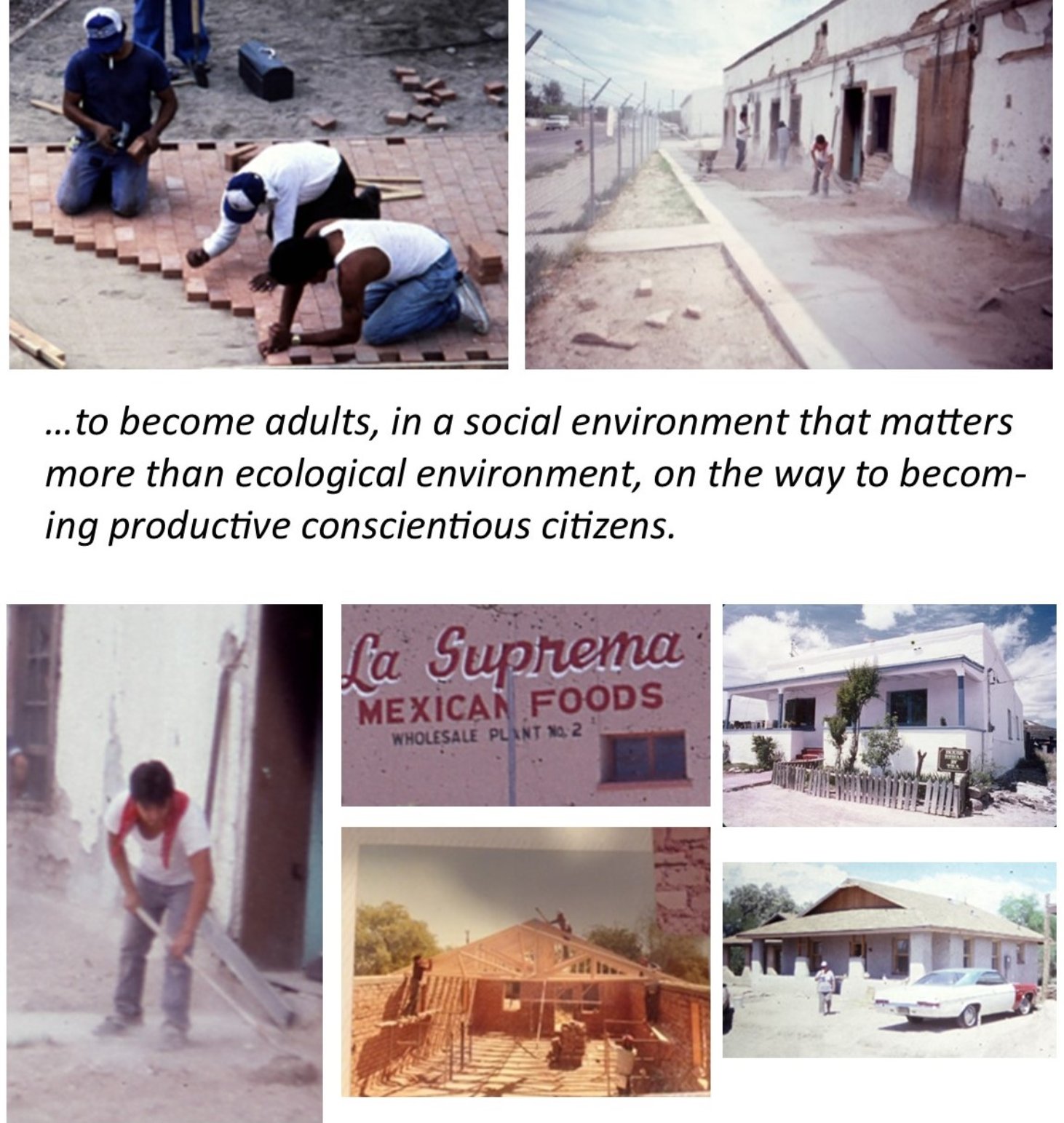 within the honest pride and the power of being an American.