City pressure was finally beating me up. In almost ten years, after fixing 130 houses, seven new ones, a park, a pool, many events, a commercial investment in adobe making, the Tool Library, a year of work for thirty-two kids, helping leading to rewriting building codes on adobe, forming neighborhood coalitions, a whole Neighborhood entered in the Historic Register, enough successes to turn a neglected neighborhood around, and although surrounded by people, once again I found myself alone, and deep in introspection. My romantic life had fizzled again, and the day was heading toward a very lonely night. I was feeling down and out. Too many things were going haywire, and dismay cloaked my thoughts like a wet, heavy blanket. My friend Ray had gotten an assignment elsewhere and was not available for sounding off.
Late this afternoon, as the only customer in the dark, empty Cushing Street Bar I was nurturing my favorite drink, a Rum and Coke or Cuba Libre, the only one per day I could afford, while trying to catch up on some paperwork. Probably tallying up an old monthly mileage report among other things. Fortunately for my empty pocket, I was not a heavy drinker.
I treasured those seldom moments of complete isolation and sense of doom. They are very reassuring because you come out of them and realize that life is not so bad after all. Good things are always around the corner. Struggle is part of the important range of emotions to keep us in tune with good health. Besides, tension leads to equilibrium. Like the pain you feel at the end of a marathon. It hurts, but you know that if you finish you will recover even stronger, but was there a finishing line in this struggle? Would the families be able to live in their new homes?
Simple events can have radical effects. What would have happened if old Jose had not heard Susie talking to Ellen? Or if I had not paid attention to Jose? Or if talking to Ellen afterwards had straightened things out? And what if I had not given the Board such a stupid ultimatum? Simply changing Susie, who was incompetent in that job, would have meant that I would have stayed in Tucson and the consultants from New York and the City would not have found all sub-recipients ineffective, we would have completed all the rehab and would have continued with future Self Help Housing groups in and out of the Neighborhood.
Of course, this type of thinking is useless. Hypothetically, worse things might easily have happened. In the next few seconds, I was about to experience another simple event with radical consequences for me and the future of the families, what if I had not been drinking there that afternoon?
I was contemplating the cultural changes in behavior caused by the influence of our environment as we grow. Adolescents peeing in the street had not been seen now for years. Yet, the same people were still living here. Why was that? My tired mind was skimping all over the place. What forces causes us to choose to do good or evil? Do we enrich or cause harm to others on purpose? Is that important?
Certain acts define us as humans. How much of it by choice or absorbed from those surrounding us? Sharing the power is a key theme throughout the book. This is a difficult concept to follow for many people who have power, and a non-intuitive move for the ego who has struggled in an unfriendly environment trying to reach personal power. However, in a democracy, in the trickle-up capitalistic process, the teamwork of personal competition sharing of power is the high-octane fuel in a turbo engine.
No culture is all good or all bad. We all look at the positive in our arguments and the negative in the arguments of others. We all share imperfections, the need to improve, and if you reinforce the positive it will bring out the best. The kids in the Barrio were a good example.
I rolled the ice in my glass, clicking crystal sound, took a sip through a red, thin straw and remembered incidents of the last few years. I saw great changes in the kids. A few things they did were no good, but then again, as a kid, I may have done similar things, such as throwing eggs at somebody’s garage door, but that was poor behavior, not evil, and neither I nor the young men were doing that kind of thing anymore.
Don’t we often read about fraternities and sororities in Elite colleges openly engaged in worse illegal and immoral binges? How do they compare with the behavior of Barrio kids? The same! It all depends on which side you stand on. Sometimes fraternities are more ignorant.
On a more positive side, I thought of Charlene and the movie projector incident and her friend Isabel. What were they doing now, nine years later? Last time I saw Isabel she was going out with the younger brother of a member of the rehab crew, a nice kid. And Linda from the Creative Teen Power who built a wooden bench that was really a piece of sculptural art, she had talent! And the three murals by the kids from the same age group. All that raw talent, but what we tend to remember and point out to others in disgust is the peeing against the wall, or the inappropriate whistling at a woman, seldom aware or eager to encourage or praise that latent talent.
The negative things are the ones that get pointed out as justification when one group is pushing another out of their habitat. Colonizers pointed out the atrocities by Indians, while Indians criticized colonizers as speaking with forked tongues. We tend to see misbehavior in others as less justifiable than our own when in fact, ours may be equal or comparable, maybe even worse. He who points one finger has three pointing right back, but that day I was feeling the weight of a responsibility I was not equipped to carry. I had gotten in too deep. I was stepping on too many powerful toes and could not in good conscience figure out how to pull out, and I could not pull out. I sensed the worst was still to come. I had to hold this tiger by the tail, all the way to the end, and there were too many people with greater resources who instead of trying to help, they were trying to undermine the TBA’s years of effort and doing so by striking at me personally, and why. Was what was going on in the Barrio really that important? Out of proportion for a simple Barrio. It was curious how different elements combined to oppose positive change. People began to say things I will not repeat. I meet people I didn’t know, yet they would give me angry looks, for others had smeared me all they could. I had been threatened with body harm by people unknown to me for things I didn’t know anything about. Who set them up to it? When they can’t fault you on your actions, they smear you on a personal level. Was I fooling myself that I made a difference? Maybe I could quit, and no one would know or notice, but then, I thought about never, never giving up. Could there be exceptions?
That day I was hungry and as usual, I had run out of money, and I had recently lost a wonderful girlfriend because she needed more of my time. All these years in Tucson and I had nothing.
At least one minor positive incident compensated the many negative ones.
The constant daily tension and watchfulness against the City’s divisive actions made it inadvisable to take a distant job from the Barrio where I could not then be present at the right time. I was getting hungrier day after day, and I was getting used to it. I did not have enough money for gas, or for coffee at Café Olé. I had already sold my motorcycle. I had discovered that if I walked to Cushing Street Bar at 9:30 AM, before it was officially open, the staff in the restaurant would be setting up and preparing for the lunch crowd, and they had a pot of coffee brewing to help them get going. They did not mind if I came in through the back door and served myself a cup and sat quietly in a corner while sipping coffee and trying to plan the day ahead. Where to go to find work? I found a few odd jobs close by here and there, 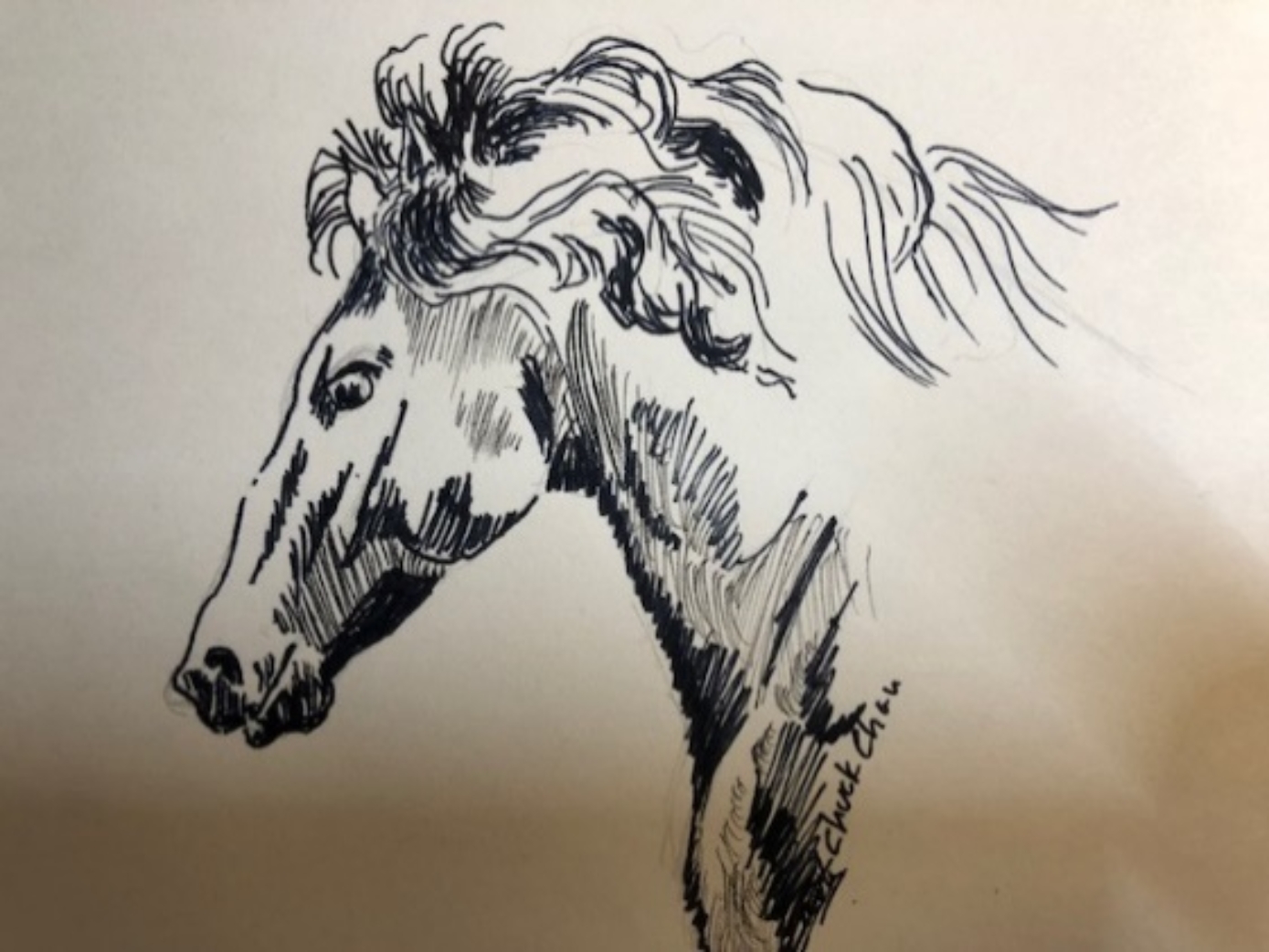 but I needed a permanent part time job.
One such morning, I did a sketch of my favorite horse jumping over a fence, and on an impulse, left the drawing behind on the table as a tip. The next morning when I came in, there was a steaming hot cup of coffee on the table waiting for me. I left another drawing.
That evening I had done a menial job and had some cash, so I went to the bar for a beer. When I went to pay, the waitress said “No, that’s on me.” I understood the hint. I left her a drawing. From that day on, until I found a job that changed that routine, I left a new drawing and I had coffee and bread every morning and free beer every night. I could hear from the kitchen the argument going on as to who was going to take care of my table that day, they were fighting for my drawings.
However, that day was not one of those days. There was no waitress. I was concerned that if others ever found out how little I knew about bank lending, real estate, and property rights, I had never been a homeowner myself, how easy it would be for lawyers to trick me. When the situation turns on you, those around you tend to disappear, or you avoid them. It was depressing. I felt vulnerable. I had many doubts. What if I was doing it all wrong? What if people preferred to have things done for them? Getting into scuffles with properties that were not even mine? What right did I have to involve others in a two-year commitment of building their houses, and what if the City overrode me and took their houses away? You can keep shadows at bay, until they all come crashing in one day. The light at the end of the tunnel was gradually disappearing. Enemies were multiplying. My mood was overcome by a painful darkness. Right or wrong, I felt the weight of isolation. Was I ignoring my errors?
A harsh noise at the front door made me look up! The silhouette of a large heavyset man was framed against the outside glare of the setting sun. His face was in darkness, the outline of a mustache extended past the side of his face, but it was not anyone I knew. I looked back down at my papers. For some reason, the hair in the back of my neck stood up and the song In a Little Café in the Other Side of The Border came to my mind. “…She belongs to that man called José…” The music played in my brain. “ …Come a little bit closer… You are my kind of man…”
Nice song. “…And the night is so long…” Other thoughts began to whirl in my mind. I remembered sitting in the back seat of a lowrider surrounded by six shadows bigger than I. I looked up again and the big man, with his mustache moving up and down, was leaning over the bar and looking down talking to the bartender. In the shadows, they both turned to look at me. My heart skipped a beat. My stomach knotted. A drop of sweat began to trickle down my neck, towards my back. The song in my head said, “…José is on his way…” Oh, Oh! Had I made a pass at the wrong female lately? Don’t pay any attention, you are getting paranoid. It has nothing to do with you. I kept working on my papers, but it was hard to concentrate. My brain was scrambled. I looked back down at my hands and all I could see was a blur instead of a pencil. Then I heard approaching footsteps and I had to look up again. The large man was coming toward me, a dark, dark object in his hand. The song went on in my head, “…And I knew, yes I knew I should leave, When I heard him say…” Was the back exit door unlocked? I wondered.
Could I hightail it out of there in time? But I could do nothing but look up as the unknown man came up to me, larger than large. Extending his hand in front of my chest, he put a Cuba Libre drink down on the table. The ice tinkled in the glass.
“I like what you are doing in the Barrio,” he said. Turning around he left the bar the same way he came.
That one action by a total stranger gave me enough uplift to sustain me for the rest of the odyssey. I will never forget it. Even today I get chills when I think of the unexpected goodness in some people. There are seven families that owe the completion of their homes and life in peace and harmony, to the actions of that one man. Thank God for good people!