I had been living in the Barrio for just five months, and I was going to a public meeting about an action in a city, a town, a neighborhood, I knew little about and had no attachment to. Some families in that neighborhood had been living there for four or five generations, many of their kin had left by attrition or by moving up in the world while the Barrio conditions went down. However, many of the important Hispanic families in the City had their origin in that Barrio before they moved away. Many still had relatives living there, grandparents, cousins. As for me, I had just landed there by default. I was a newcomer.
Several professionals, including city planners, investors, architects, and urbanists had invested considerable time in planning and plotting from a distance over the new expansive developments, speculating in how much economic development it would bring to the City of Tucson, as well as their own personal and professional income. I should have been one of them as a graduate, working for an architect or planner in an air-conditioned office. Maybe in the future, but that day I was sore from a hard day of hammering and had a sore behind while sitting in the back of the room, on a hard wooden bench, listening to ‘experts’ in the field, not knowing I was about to abruptly put an end to their sophisticated plans.
Sitting in the back I kept my mouth shut, until towards the end. Three polished consultants from New York had conducted an extensive study of the Barrio. They set up a table with a projector and opened their briefcases full of papers and a slide rule, a technology I familiarized myself while in school, and they began their meticulous and remarkable presentation on the procedures and methodology of their study. They substantiated their persuasive arguments with figures on rentals, homeownerships, printouts of tax records, and new constructions, or rather lack thereof, collected over the years. They added other significant data that caused them to arrive at their final conclusion.
Straightening his tie, the head of the group got in front of the room after turning off the projector and began his summary.
“The result of our extensive study is that the area bounded by these markers in red,” he had a map of the Barrio, only the Barrio, not Armory Park Neighborhood, outlined by a red magic marker, “this area here is a very unstable area. This is a very unstable neighborhood. The rental ratio is more than 80% according to the City’s tax figures, and the owner-occupant homeownership is less than 20%. There are many vacant and semi-abandoned houses, and most owner-occupants are elderly, which means that soon the ratio will be even smaller. Besides, the rental population shows to have an average stay of less than two years. There are numerous empty houses and lots with new permanent vacancy at a rate of five per year with no new construction taking place to replace the ones lost.”
Devastating! Profound! Conclusive! My jaw had dropped open, but something didn’t sound right. I thought I knew a little, just a little about the people who had lived for generations in this Barrio. Were they talking about the same people? I saw nothing that would indicate a transitional or unstable Barrio at all. A lie.
My hand went up. Was it my hand? Somebody’s hand attached to me without my conscious consent went up.
“Any questions? Yes?” the professional pointed at me. I stood up. As I was standing, I had no idea what I was going to say. Then I opened my big mouth. It made noises that would change the course of my life and my ideology. It would determine the next ten tumultuous years of my existence.
“I heard all that you said…,” I began tentatively. Everyone present had heard all that the presenters had said. “But I also heard what you have not said.”
Now I had to think fast about what it was that they had not said, as if they had left any room for unspoken words.
“I know, Señor Perez,” thinking faster at a fleeting thought but slightly making some things up as I went along. I proceeded, “he has three daughters, and a son who is right over there.” Señor Perez had a different number of children and different type of house, but I didn’t know the exact number, and my example was still accurate, however, accurate truth is seldom important in public meetings as was to be demonstrated, unless you get caught in the lie, and I did catch the consultants lying. “He told me that when each of his daughters get married, he would build them a house adjacent to his, sharing one wall, but it was on the next lot. So, he built three houses next to his, two on one side and one on the other, with a door on the back room connecting each of the houses.” I made the part about the door up. I would have done so if it were my house, but that door was purely imaginary. Had they known the Barrio they would have caught me in my ignorance. “When you look at the tax records, you see Señor Perez as a taxpayer, an occupant property owner. But you see the other three properties with different resident’s last names than that of the taxpayer Mr. Perez. The daughters’ husband names show as residents and so you call them rentals. Now, you say it’s 25% owner-occupant and 75% rental, when in fact, it is 100% owner occupant, as it’s Mr. Perez’ own family and they will inherit the property. One hundred percent same family ownership for hundreds of years.”
Before I could take a breath, so they would not stop me, I went on, “…and I know Señora Valenzuela. She is sitting over there. Her son Jerry helps me now and then with my house.” I omitted mentioning that his help was only to tear things down. “Señora Valenzuela is a widow. She rents. She likes the Barrio a lot. She has moved three times in the last fifteen years, every time inside the Barrio. She shows up in your figures as three separate renters, but she is in fact a very stable renter in this Barrio. Fifteen years is a long time. The average American ownership of a home is seven years nationwide, and she has rented here for longer than that. In addition, just like her, there are many growing families, including relatives who rent from relatives and move from house to house as family size changes. This occurs so much that I would consider this a very stable neighborhood, at least 80% or more homeowner-occupant and a very dedicated, stable rental population. If we do not consider the very small gentrification that has taken place recently, I would say this is THE MOST STABLE NEIGHBORHOOD in the entire City of Tucson, if not in all of USA.”
What did I know? As if I knew about any other neighborhood in Tucson! I sat down. The meeting came to a halt. The consultants closed their mouth. Then they closed their briefcases, unplugged the projector, and walked out of the room. We never heard the city talk about demolition of this “unstable” neighborhood again. Misinformation was produced and paid for by the City to justify their ends, a lie. Today, anyone could argue that another reason they could never talk about demolition again was yet to come. It was to be a few years later due to our entering the neighborhood into the National Historic Register, but this incident delay their intentions long enough. Slowly, I began to make some enemies. Separately, without my realizing it, several people were now looking at me with appreciation. If I had not spoken that day, this book would not have been written.
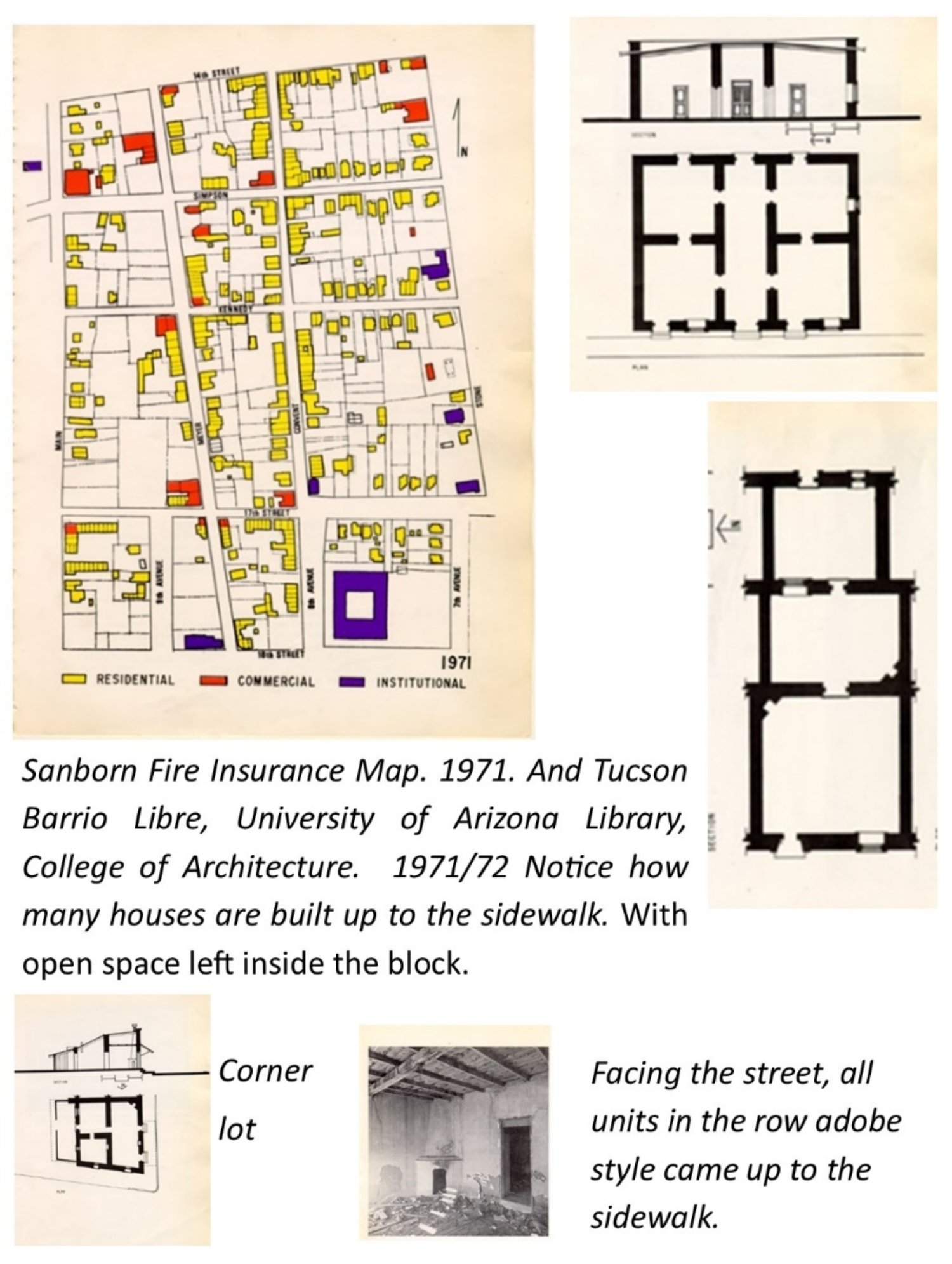
Ironically, the University of Arizona, College of Architecture, had done a study four years before,1972, highlighting the historic value of the Barrio the City now intended to tear down. Confusing! This insurance map below used in the abovementioned study shows only Barrio Libre. Notice how many houses are shown built right up to the sidewalk.