Judge Collins and Dave Parslow
Soon thereafter, depth and meaning came about due to the article in the newspaper about Carmen and her plight. Dave Parslow, who had never been associated with the Barrio, came to talk to me one day. Dave and I became very good friends. He was one of the few open-minded people I could talk to, even if he mostly advised me to take a different direction, not always agreeing with me, but he did understand the reasoning behind my views. Dave had been in the CIA stationed in Japan for a while, and he knew more about the blemishes in this world than I would have known about poop in my fishbowl. However, that first day I didn’t know him. He wanted an interview for a speech centered around the Barrio that he was drafting for Judge Collins to be given to the Democrats for Greater Tucson.
Out of Dave’s mind, came a speech by the Judge that made the news and set the stage for much more to come. The Judge said something many took notice of, and even angered some.
“The Mexican American nuclear family is being destroyed in the name of history, so that history will be retained without content,” with the most controversial ending: “displacement... by people who borrow other people’s culture because they have none of their own.”
I didn’t know it then but by his questions and comments, Dave ignited in me a desire for a deeper understanding of the nature of what surrounded me. That interview/speech, was my catalyst to social awareness. Like a dog with a bone, I got more and more immersed in a turbulence that was to build up in stages and eventually boil over, leaving a series of more than eight results of historic resonance in the Barrio. What the Judge didn’t say, but Dave woke up within me, was “to share the power”.
Sharing the power was essentially responsible for explosive ‘firsts’ that took place in the following years. A few firsts in Tucson at the time was converting an entire neighborhood as a Legal Aid client. Then fighting the city and winning in getting Carrillo Swimming Pool to be opened again in a Barrio used to getting run over. Subsequently, we entered the entire Barrio into the National Register of Historic Places. Additionally, we initiated an economic development business with mud adobe. The community building a park. Then came the most significant to me, one of a very few, if any, Self Help Housing Project in a Historic Neighborhood within the inner city. We built the first adobe new construction homes with private and government financial support after the reversal and revised acceptance by the Standards Federal Building Code accepting adobe as a valid building material of which we were part of. We executed the first Neighborhood Watch Program over an entire well-defined area. We also created a comprehensive rehab program using local labor as a sub-recipient of HUD funding, using a local rehab crew to fix Barrio’s homes. Plus, we established the very first neighborhood tool library to help make more restorations possible. You would think we would receive elected officials’ follow-through support! But “no good deed will go unpunished.”
Seven years later, while still trying to come up for air, I would be asked by the same group of Democrats for Greater Tucson to give a speech to their group, as Judge Collins had done years earlier. It went well that time, but nothing memorable. I had not fully wrapped my head around verbalizing the dominant significance of sharing rather than hoarding power. However, when a similar request by the same group came two years afterwards, now with lungs full of fresh oxygen, I made the mistake of giving them a draft of my intended talk. By then, I knew too many of the skeletons in the city’s closet, and what needed to be done, the difference between sharing and hoarding power in and out of world politics, which I meant to expose. They cancelled my speech. I had woken up to the fact that things are seldom what they appear to be. I no longer agreed with everything the Judge had said in his original speech, but all this comes much later, and Dave Parslow’s razor-sharp questioning was much to thanks for loosening up the avalanche to come.
There are several narratives I will indulge in first. Using details build upon each other slowly at first, each leading up to specific struggles in the Barrio. They are important in explaining the reasons for the mental challenges we faced and the struggles we fought. Also important, because most of them are also present in our entire nation and even in the wide world, world power anywhere, such as the battles to choose between dependency and self-sufficiency, federal and local power, parental choice in a child’s education, socialism and capitalism, collectivity and individualism, control in global affairs, social justice and just plain down to earth human justice, individual and popular wisdom in a democracy versus an oligarchy, and more.
In between episodes, with the money left from the carpentry job, I took a trip back to Oregon, this time taking Jerry and José with me with a letter of permission from their parents. Their numerous friends, who didn’t know where Oregon was, came to say goodbye as if they were going to the end of the world. After three hours on the highway, both were asking for the tenth time the same repetitiously annoying question, “Are we there yet?”
I had been through these lands many times before, but they had not. In their entire life, they had only left Tucson’s city limits to go to Nogales about sixty miles away.
When arriving by the vast Pacific Ocean in California, the eyes of these two desert rats were as big as soup plates looking at that much water. We drove up Highway One to Oregon and every five minutes looking west they would ask, “Is that the same water?”
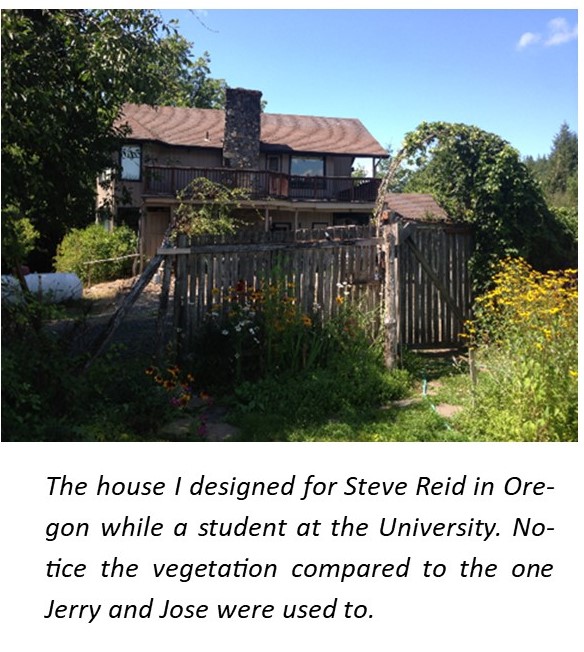
We went to visit Steve, the happy logger in his new house in the mountains, and I thanked him once again for helping me get my first pickup truck. The forever-green forest of Oregon culminated the boys’ exposure to a world previously unknown to them. It was so utterly different from their old world where river water only flows a few times a year.
But if I thought that these two kids exhibited naiveté and inexperience, while visiting Bob, a friend of mine at the University of Oregon on the campus of intellectual center of civilization surrounded by the elite, or the elite-to-be, the Barrio boys showed me otherwise.
As we were talking to Bob next to his bicycle leaning against a tree, surreptitiously Jerry and José took, or stole, the bike from under our noses and hid it, and resumed their part in our chat. Neither Bob nor I were aware of them doing it. Bob had to walk home. When they admitted their prank later, I made them return the bike. Who was naïve? That took brain, talent, and skill! Misdirected talent perhaps, but these kids used their brains in how they distracted us as they took the bike. I was impressed! Sad to see good brains go to waste. Can we change that?
I digress by telling this story because it’s my belief that every youth should spend at least one year in a foreign country exposed to different norms and conditions. A trip to Oregon was all I could do for them, close enough at the time. How to cut cost and make universal this idea that young adults should be exposed to distant cultures and ways of thinking?
Back to Tucson, as stated Ray would rather talk than act, while I would rather act after the talk. And yet, it was from him that I learned when to act and listen rather than talk.
“Quit poking at your ear, Ray,” I told him in jest one day. “Why do you have to search for gold dust in the same place every day? There is none there.”
Ray ignored me. I would have done the same. He was not the usual friend. His ears were normal. Maybe that was the only normal part of his face and because of that, they were the first thing you noticed on him. The remaining details of his face were so unusual that in its totality, the result was rather pleasant. I would use his face later to describe the value of diversity when it formed part of a cohesive whole. The rest of him was not that bad. He was tall and lanky with fluid movements that seemed as though he was going to crash at any moment, but always ending precisely where he was going. Ray had that rare talent of sensing more than seeing what a person was made of, and he was proud of that.
“I don’t believe you can sense goodness in people,” I told him. “What are you doing hanging around me then?” There may be exceptions, he would admit. I hardly ever saw him anger anyone. He was aloof but was always there for you. He would literally give his only shirt from his back to someone shivering from cold. His good lesson came one day. We were walking, when a panhandler approached us asking for money. Ray rejected giving him money but invited him to have lunch with us. I wasn’t happy because he didn’t ask me and I was the one paying. After a lengthy lunch, in which the poor man told us his whole sad story, I asked Ray why he took the time. It was obvious the man’s sad story was all made up. He would have spent the money on wine if we had given him cash.
“Of course. So what?” he said. “You will spend ten dollars on a good book, and half a day to read it.” Well…, it took me several days to read a whole book. He continued, “Today, for less than two dollars you heard a very creative story, fiction or nonfiction, what is the difference? And he didn’t spend our money on wine. After all, how many attorneys etc. spend their money on wine?”
“Attorneys don’t beg, they steal. Do they ever turn down your invitation for lunch?”
“Yes. Often. Many of them want cash to buy wine.” He knew the game they played. I never forgot that lesson. Never money. Yes, to good healthy food. Full attention to the story for the value it now suddenly had provided me. Life is full of gold nuggets in unsuspecting places.