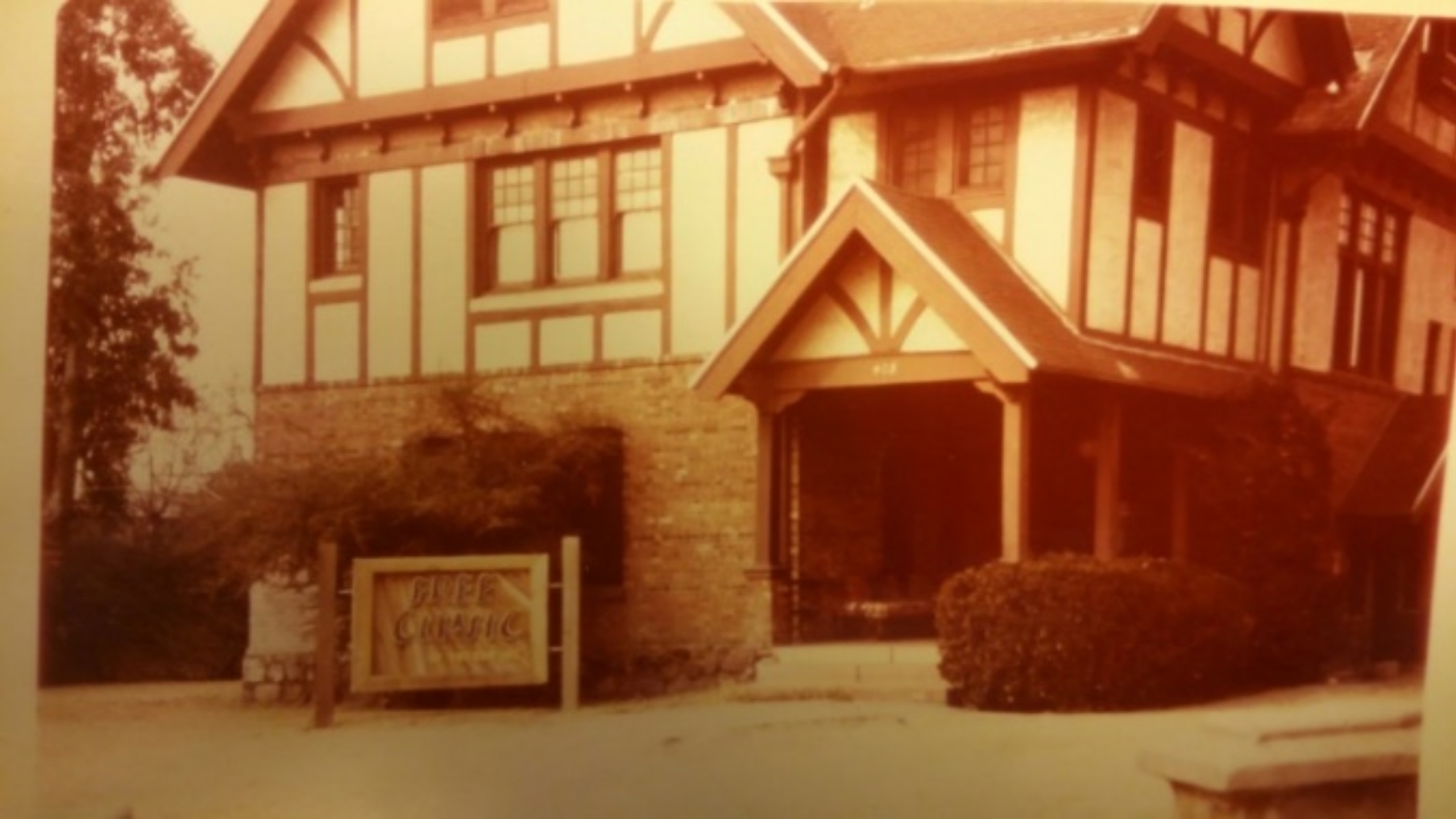
 A woman’s lib group, along with other sub-cultural groups, got funding for a free clinic, and then they were offered a nice large building for an alternative health clinic (Tudor Revival, 1920-1940’s). With a small paid staff, volunteers, and volunteer doctors, they catered to people who were not comfortable with traditional medicine.
On impulse, I applied and was hired as a Follow-Up Coordinator. At first, I did well. I have very good memories of a fabulous learning experience. The clinic did wonderful work. I am sure numerous young people benefited immensely from the work at the free clinic.
We learned how to train volunteers to take blood pressure, blood samples, following doctors’ directives, and preparing the patient for the consultation with the doctor, and more.
I made a large sign for the front of the clinic to go with the beautiful old Victorian mansion, as seen in this picture. My carpentry was improving. My role was to telephone past patients with a follow-up call and ensure that their health was improving and scheduling a return visit if necessary. Even a simple message of ‘we care’ and the question if ‘all is going well?’ was important enough.
This was not my life-calling despite a desire to do well. As a male, I should not have been doing follow-up calls with female clients. When I called Susie and her boyfriend answered, jealousy would flare up just from the sound of my male voice asking for Susie. If the mother answered and I asked her to leave a message for Susie to call back the Free Clinic, the mother would want to know right away what it was all about, why did her daughter have to go to a clinic behind her back? Soon I learned to lie and explain that we were looking for volunteers. If I left only my name, not knowing me, Susie would never call back. When Susie did answered, there could be an embarrassing moment when asking whether the vaginal infection was gone or not.
I did not do well, and I didn’t know how to convey my difficulties to the rest of the staff. I thought the problem was with me not knowing enough about how to do things in their world. I should have quit much sooner, but it was a wonderful place to work, and I met fascinating characters, but not Hispanics or Blacks. The doctors did not have uniforms and there were no nurses. Hispanics in Tucson liked the formalities of conventional medicine and did not frequent the Free Clinic at all. The answer I would get from the staff was a puzzle, “If Hispanics and Blacks don’t come, even though we are free, we are not going to change our ways to appease their minds.” This was like a Catch 22; “because we are so nice to them, they should come, but if they don’t adapt to our enlightened ways, it is their fault.”
As one of the few males among females, I felt confused by the lack of connection in the transfer of information. Males and females are not the same, and as a minority here, I understood better than before why minorities often feel alienated. There is a nonverbal language you acquire in competition sports, and especially contact sports, that is part of the male life and mostly absent in female company. Maybe that explains the glass ceiling. More females should play competitive sports. I felt an unacceptable pressure to become soft and touchy-feely, effeminate, to fit in, more than just learning to express feelings. Another confusing message was on conflicts in sexual clues by women who were not attracted to men, who would openly resent any flirting made by those that did. Those that did would compensate by acting cold when in groups but not when alone. I had no romantic relationships with anyone at the clinic but learned about male-female dynamics from a minority standpoint, and about female-female dynamics, and their view on male-male dynamics. Not all of it was good, much of it was rumors of corruption and power struggles. Before I left the Free Clinic, I went through a series of incidents that had no direct relation to the Barrio, but they did affect my outlook on life and how to interpret the complaints of the so-called ‘minorities’ of any kind. Evil lurks within ‘minority’ groups just as with ‘majorities.’ Not to minimize our responsibility to see beyond our comfort zone, when we are concerned with the plight of ‘minorities,’ we tend to sanitize so as not to demonize, and we fail to solve the real problems for the simple fact that we fail to see and deal with reality. We all need to understand our weaknesses and overcome them. We must replace them with strengths. I included.
One example is that even if I grew up to respect the ‘gentle gender,’ often among male friends we engaged in disrespectful and demeaning conversations about females in general, and sometimes I felt conflicted by that. However, I learned that when the female staff and volunteers forgot I was present, their conversation about males was by far more detrimental. That was news to me, I had never known that. But before complaining, I had to further clean my own house first.
Soon after I left the Free Clinic, I joined the Board of Directors of El Rio Neighborhood Health Center, an HMO when bureaucracy did not spoil HMOs, as they are today. Putting emphasis on preventive medicine. Funded by the county, I met impressive people from the medicine field, such as Dr. Herbert K. Adams, a founder of the clinic. To our surprise, he picked me up one day as I was hitchhiking to a board meeting. Here I did well.
The doctors wore capes, and the nurses uniforms. Many of its patients were Hispanics, Blacks, Asians, etc. Once I stood in favor of allowing one staff to run for the board to represent employees. Could this be a good way to balance the powers? The employees lost; so controversial that the matter ended up in court when the one deciding vote was questioned, but that is another topic.