Chris Delaporte came back from Washington D.C. to Tucson, and true to his word, he met with us. Ellen and I took him around the Barrio. Conscious of sharing power, we took him through all the surrounding neighborhoods as well, pointed their significance in history and architecture each with their unique qualities.
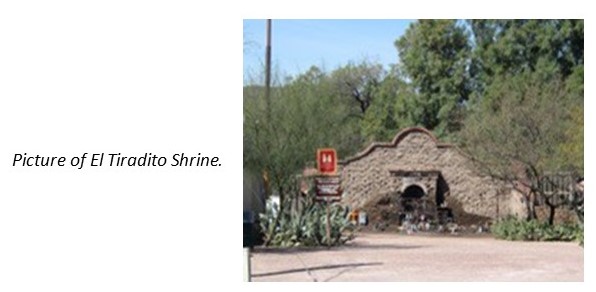
Our neighborhood was not a stranger to the National Historic Register of Historic Places. In 1971, El Tiradito Shrine had been listed and before that, for a hundred years, it had been a significant tradition in the Hispanic folklore of the American Southwest. This century old shrine now stood at the entry of the remaining Barrio real estate.
As the Shrine of a Sinner was incorporated into the National Register, it prevented the state from using eminent domain to expand a state freeway right through the neighborhood. With the entire neighborhood entering into the National Historic Register, it became the reason that all levels of government henceforth would be prevented from demolishing more buildings. If any municipality tears down a building or monument which is registered in the National Historic Register, they lose all Federal funding.
As we were driving around in my pickup truck, Delaporte noted,
“But there is so much empty space inside the blocks, and between some buildings, and several different styles of architecture. It makes it difficult to be selective in our choice for nominations.”
“Here in the Hispanic culture,” I subtly responded, “the empty spaces between buildings, and in the center, are just as important because of the family’s interconnections, the way the extended family keeps in touch with each other. That space forms part of what holds them all together. In this case, it is also the material of adobe, the age of construction, consistency of style throughout hundreds of years, and the lack of recent intrusions. It is not just the material per se, for there are barrios without adobes. It is how the culture adapts and adopts changing standards, the sum-of-it-all to reinforce the essence of their culture. But the important part is how the entire Barrio holds together which includes the spaces in between, in ways we can’t see.”
Delaporte was skeptical to a point.
“Spaces in between? All I see are empty spaces.”
Even planners and archeologists are supposed to know precisely how this works, but they don’t, and neither did I. However, the idea kept nagging on me in the subtle way in which empty or nothing affects something in space and time. Sometimes, if all we do is dig deeper into what we already know, we miss key elements. We miss what we need to know. We must be open to what we don’t know and from directions we do not recognize. Set aside the usual. How would you have explained vacuum when the phenomenon was not known?
Or magnetism? How do you explain the color green or blue to a blind person? This mystery of cultural use of what seems like empty space could be one of the deepest questions I raise in this narrative; it relates to architecture and psychology. I barely touch on it. It’s for others to answer. It’s a mystery that affects cultures in different ways. Culture is built upon from the day-to-day experiences of normal people, not by the luxury of palaces and monuments, although these may contribute to it. By its unique architecture and urban development over time, this Barrio has the answer to this mystery.
If we could only see it, what is not there to us now, we could then unlock the mystery to our relationship to space - solids and voids and distances and technology and unlock more hidden mysteries of culture. While Native American Indian cultural sense of time is very different from ours, they tend to measure time by depth and impression of events in oral communication, not by clock measured minutes in visual, linear and numerical transmissions, how much of the same thing may happen with the sense of space? How do cultures measure the sensation of space, movement, time, cause and effect, fate and free will? Family and space is critically different in many non-Anglo cultures, and Anglos fail to comprehend that. This understanding can lead to better coexistence.