and Armory Park Neighborhood
I don’t remember extreme hunger except for two occasions, but I must have been skinny in those days. Life, like a telescope, is distant from one end, and compressed from the other end. As the Carrillo Swimming Pool chapters was taking place, a string of other events tumbled across our path.
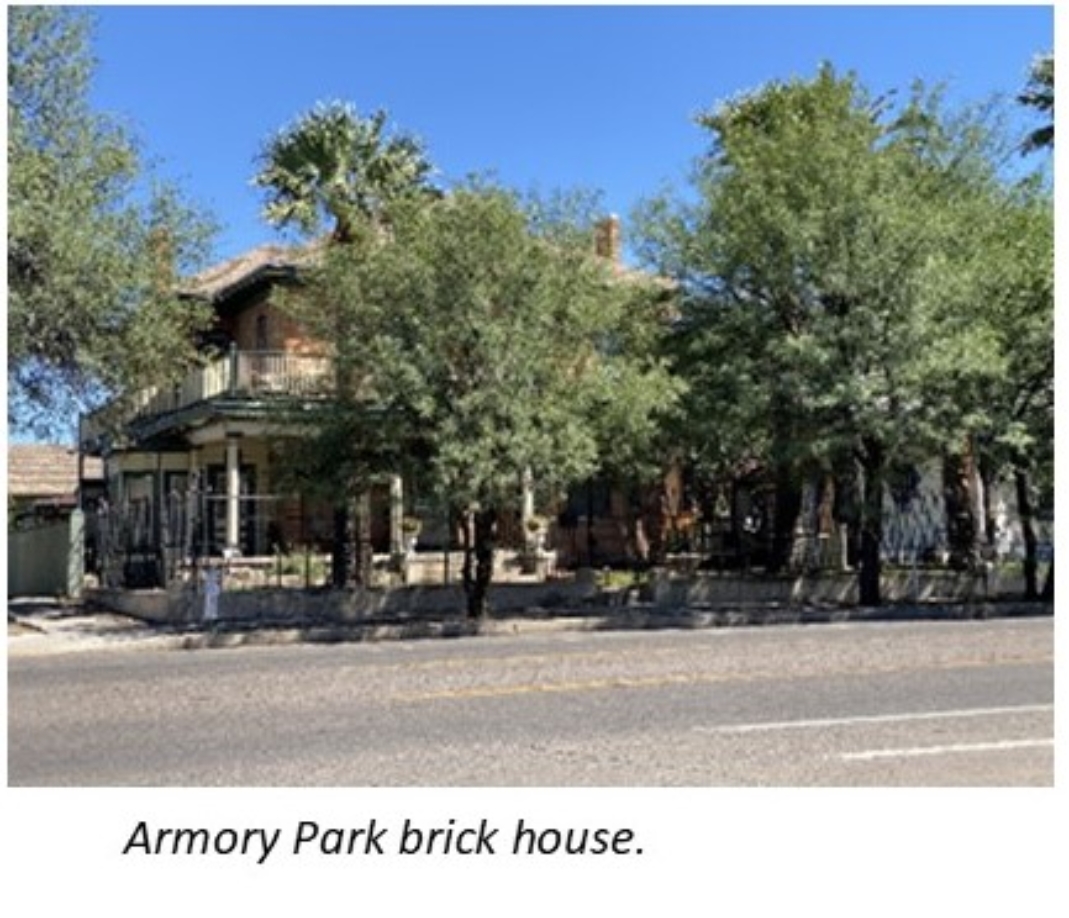
We moved into our first donated office space, half a block away from the well-planned Armory Park Neighborhood, built in 1881, when the railroad reached Tucson. The railroad brought loads of red brick, pre-cut wood, and easterners who soon developed with a cohesive plan a neighborhood which included schools, parks, churches, and libraries from its very origin. Most houses were and are two story, red brick buildings with a wooden shingle pitched roof, on single lots, designed for the officers and staff of the railroad industry. The technology of the RR changed the direction of commerce from north and south, to east and west.
Instead, our Barrio had been taking long centuries of unplanned growth, generations of families multiplying and growing organically following a vernacular architecture with no formal original plan, but with an intrinsic value, around family interaction, giving the Barrio its unique and cohesive character.
Personalities in the TBA, Armory Park and El Precidio Neighborhood associations formed a good alliance throughout the years. Strikingly, by crossing a single street, everything tangible changed such as style of hats, shoes, types of jobs, trades, food, stores, low riders, churches, religions, schools, books, magazines, type of ventilation, language, bicycles... Despite representing different cultures and needs, but fighting similar battles, we helped each, founding historic value as common goal and City government overreach as a common enemy. While diversity can divide, historicity was the glue that held us together. And sharing power is also enhanced by good people and good use of mutual opportunities[xxiii]. Diversity is divisive unless it has a common bond. After our sub-recipiency, other neighborhoods got theirs.
Despite the office, and volunteers, I kept spending time at Café Olé. Years later, I would be accused of doing no work and spending my time dillydallying in the Café, but when the actual money arrived for the TBA, the critics were the first to come looking for some of it. Not all needs are equal, that’s life as usual.
Close by I found a room to rent in a large house, newly owned by a married couple who converted a room into a bed, bathroom, and a kitchenette unit. Often done without permits, this was becoming common in the neighborhood to pays for the new owner’s mortgage and property taxes, while keeping homestead exemption and skip paying income taxes on the rent. Previously owned by a large family, now owned by economically savvy, renters, part of the economic change affecting the neighborhood. By renting I was again naively taking part in this process of gentrification, while I thought I was working at diminishing it.
Things are not always what they seemed, and what is a good move to some, may not be so good to other. Creative knowledge in legalities, economics, and technology will dictate who survives conflicts in a neighborhood in transition, with none-enforceable codes grandfathered in for lack of uniformity. Next to each other we had a house/office, a restored adobe with modern appliances, a 3-bedroom house illegally modified to rent, an elderly lady in an old adobe house. All, but one, violating of modern zoning codes.
The owners of my rental room - a nice educated young couple - felt HUD money was to help those Anglos like them in transforming the Barrio to their needs, so when they applied to the TBA and didn’t qualify to get rehab funds, they got upset and evicted me.